Investment Property Loan Requirements, Explained (2026)

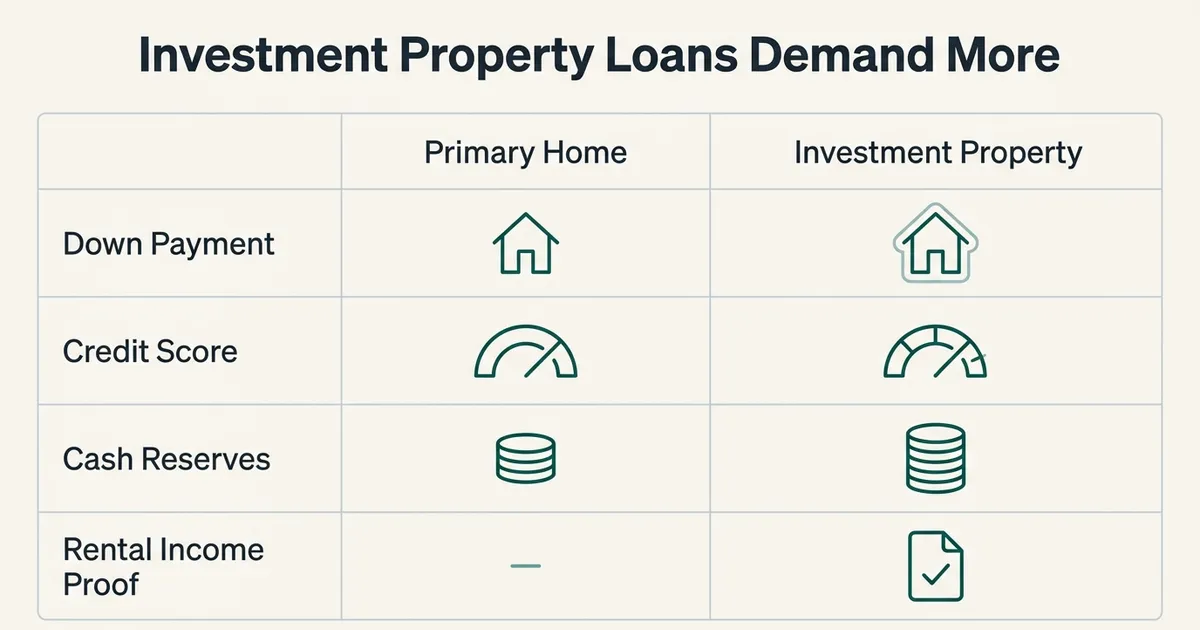
An investment property loan requires a larger down payment, a higher credit score, and thicker cash reserves than a mortgage for the home you live in. Most conventional programs demand 15%-25% down, a credit score above 680, and six months of PITIA reserves, plus proof the rental income can support the payment.
According to the National Association of Realtors (2024), investment purchases made up roughly 15% of existing-home sales, and nearly all of those buyers used financing built around income-property rules rather than owner-occupant guidelines. Those rules exist because lenders treat non-owner-occupied properties as riskier: households are statistically more likely to stop paying a rental's mortgage than their own home's mortgage when money gets tight.
What Do Lenders Require to Approve an Investment Property Loan?
Lenders underwrite five thresholds before approving an investment property loan: down payment size, credit score, debt-to-income (DTI) ratio, cash reserves, and the income the rental itself can generate. Miss any one of them and the file gets declined or repriced, even when the other four look strong.
Down payment: Fannie Mae's Eligibility Matrix caps a one-unit investment property purchase at 85% LTV — a 15% minimum down payment — with a 620 minimum credit score. That is the guideline floor, not the practical one: most lenders require 20%-25%, rising to 25% on two-to-four-unit properties, because the pricing adjustments described below make a 15%-down investment loan expensive rather than ineligible for a borrower without a strong score. Credit score: Fannie Mae and Freddie Mac's shared pricing framework (2025) layers loan-level price adjustments that jump sharply below a 680 score on investment properties, which effectively prices most borrowers under 660 out of conventional financing. Debt-to-income ratio: Freddie Mac's Single-Family Seller/Servicer Guide (2025) caps qualifying DTI at 45%, extendable to 50% only with compensating factors such as six-plus months of reserves or a credit score above 720.
Cash reserves: Fannie Mae's Selling Guide B3-4.1-01 requires six months' reserves on an investment property transaction, measured in months of the subject property's PITIA. A borrower who already owns other financed properties owes more on top of that, but it is calculated as a percentage of the aggregate unpaid principal balance on those other loans rather than as extra months — 2% with one to four financed properties, 4% with five or six, and 6% with seven to ten. Rental income: underwriters count only 75% of the gross rent shown on a signed lease or a Fannie Mae Form 1007 comparable-rent schedule (Fannie Mae, 2025), which docks the qualifying income before it ever reaches the debt-to-income calculation.
Consider a $2,200-a-month rental. Underwriting counts $1,650 — 75% of $2,200 — toward your qualifying income, not the full rent. A deal that looks fine on a spreadsheet can still fail the DTI test on paper for exactly that reason.
How Much Down Payment Do You Actually Need — Can You Avoid 20%?
You need less than 20% down in only two situations: a multi-unit purchase where you occupy one unit yourself, or a handful of non-QM programs that accept 15%. Outside those two paths, plan on 20%-25% cash plus closing costs and reserves.
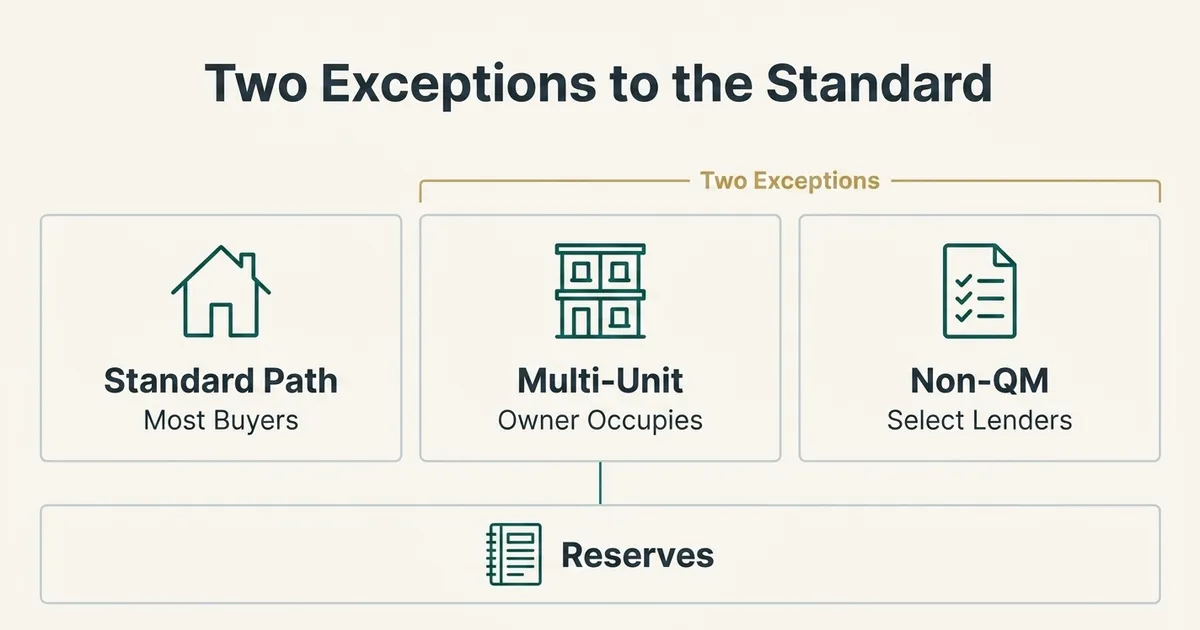
Fannie Mae's Loan-Level Price Adjustment matrix (2025) charges an extra 2.125% to 4.125% of the loan amount on investment properties compared with owner-occupied loans. That fee is why lenders rarely originate low-down-payment investment loans at scale even when the base guideline technically allows 15% — the pricing hit makes it unprofitable below a strong credit score. HUD's Single Family Housing Policy Handbook 4000.1 (2024) offers the real workaround: a borrower can buy a two-to-four-unit property with as little as 3.5% down through the FHA, provided they occupy one unit within 60 days of closing and live there for at least a year.
Run the math on a $250,000 turnkey rental. A conventional loan at 25% down needs $62,500 down, roughly $5,000 in closing costs, and about $9,000 in reserves (six months at a $1,500 PITI) — close to $76,500 in cash before you own the deed. The same property bought as an FHA three-unit house-hack needs $8,750 down (3.5%) plus closing costs, but the buyer has to live there, which works against a hands-off goal from day one.
Choose the FHA or VA house-hack route only if you're willing to live in the building for at least a year. After that, you can move out, keep the loan in place, and hand day-to-day operations to a manager — see how to outsource rental property management for how that transition works in practice. Skip it if living next to your tenants is a dealbreaker; a fully financed conventional or DSCR loan keeps you hands-off from closing day but demands more cash up front.
With $10,000-$50,000 in savings, a $76,500 cash requirement on a $250,000 rental is out of reach without a house-hack or a second mortgage against your own home. If neither fits your budget, a no-loan path — REITs, fractional shares, or crowdfunded syndications — lets you deploy that exact amount without ever qualifying for a mortgage. Compare the trade-off directly in REITs vs. rental properties before you decide which route fits your cash position.
Which Investment Property Loan Type Fits Your Situation?
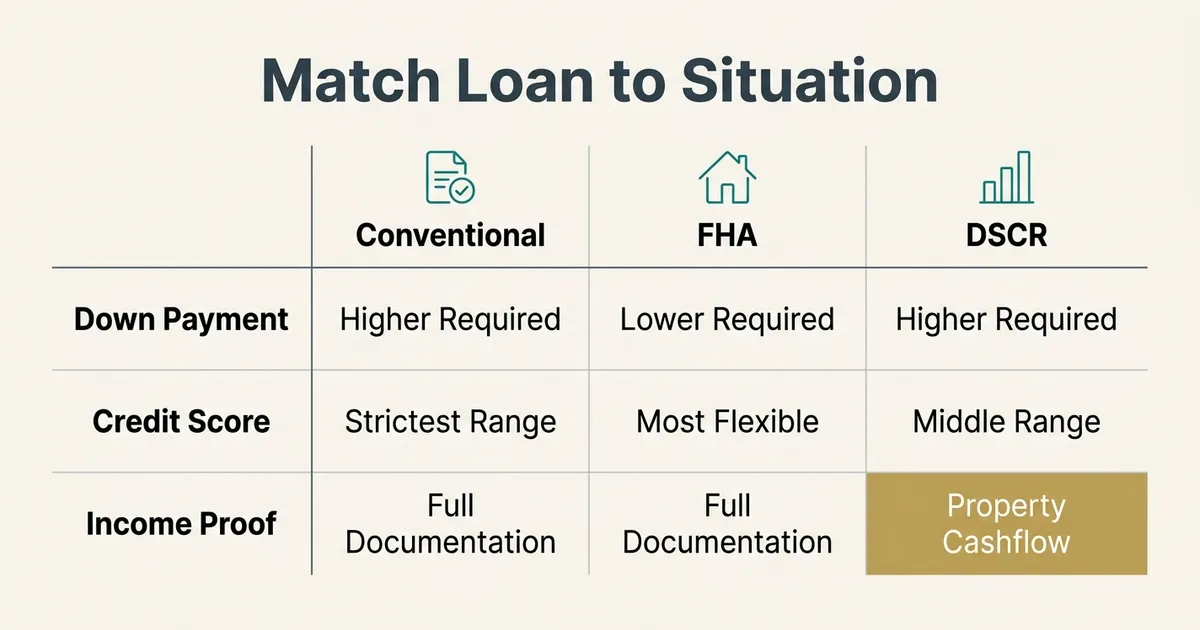
| Loan Type | Typical Min. Down | Min. Credit Score | Income Documentation | Rate vs. Primary-Residence Rate | Best For |
|---|---|---|---|---|---|
| Conventional (Fannie Mae/Freddie Mac) | 15%-25% | 680-720 | Full W-2/1099 income + 75% of rental income | +0.5 to +0.75 pts | Employees with strong DTI and 20%+ cash |
| DSCR / non-QM | 15%-25% | 640-680 | None — qualifies on rent-to-PITI ratio ≥1.0-1.25 | +1 to +2 pts | Self-employed buyers or those with 2+ existing rentals |
| Cash-out refinance on primary home | N/A (max 80% CLTV) | 680+ | Full income | Primary-residence rate | Homeowners with substantial equity |
| Portfolio / bank-statement loan | 20%-30% | 660-700 | 12-24 months of bank statements | +0.75 to +1.5 pts | Self-employed income that's hard to document |
| Hard money / bridge loan | 10%-20% of after-repair value | Flexible, asset-based | None; collateral-based | +4 to +8 pts (often quoted as a flat 10%-12%) | Short flips or bridge financing, not buy-and-hold |
| FHA/VA house-hack (2-4 unit, owner-occupied) | 3.5% (FHA) / 0% (VA) | 580-620 | Full income; must occupy one unit | Primary-residence rate | First-time buyers willing to live on-site 12+ months |
A conventional loan wins for W-2 employees with a DTI under 45% and 20%+ cash on hand. A DSCR loan wins for self-employed buyers or anyone who already owns two or more rentals and can't stack more debt onto their personal DTI. Hard money only makes sense for a property you'll refinance or sell within 6-12 months; carrying one past that window at double-digit interest erodes any cash-flow edge a low-maintenance rental is supposed to deliver.
The Consumer Financial Protection Bureau (2024) confirms that loans made to a legal entity, such as an LLC, for business purposes fall outside Regulation Z's ability-to-repay rule — a carve-out that covers most DSCR loans and is exactly why those lenders can qualify borrowers on rental income alone instead of pay stubs and tax returns. Freddie Mac (2025) also caps cash-out refinances on a primary residence at 80% combined loan-to-value, so a homeowner with $400,000 in equity and a $250,000 mortgage balance can pull out roughly $70,000 to fund a rental's down payment elsewhere — one of the few realistic ways a parent with under $50,000 in liquid savings reaches a 20% down payment on a $300,000+ property.
Why Do Investment Property Loan Rates Run Higher Than Primary Mortgage Rates?
Investment property loans cost 0.5 to 0.75 percentage points more in rate than a primary-residence loan of the same size, and that gap widens to 1-2 points on DSCR and non-QM products. The premium exists because non-owner-occupants default at higher rates during downturns; when household budgets get squeezed, people protect the roof over their own family before protecting a rental's mortgage.
According to Freddie Mac's Primary Mortgage Market Survey, the average rate on a 30-year fixed primary-residence mortgage was 6.67% as of August 13, 2026. Layer on the standard investment-property pricing adjustment and a comparable rental loan prices closer to 7.2%-7.4% for the same borrower profile. That survey updates weekly, so treat this as a point-in-time reading rather than a fixed number.
On a $300,000 loan, 30-year fixed, the difference is concrete: at 6.67% the payment runs about $1,930 a month; at 7.3% it runs about $2,057. That's roughly $127 more a month, or about $1,522 a year, purely because the property is a rental rather than your home.
How Do You Confirm the Rental Will Cash Flow Before You Apply?
Run the numbers before you apply, not after a loan officer tells you the DTI works, because underwriting income and actual cash flow are two different calculations. A property can qualify for financing and still lose money every month once you add vacancy, maintenance, and property-management fees — costs the lender's worksheet never touches.
The Urban Institute's Housing Finance Policy Center (2025) tracks a widening gap between agency-qualifying rental income and actual net operating income on investor purchases, driven mainly by property taxes and insurance premiums rising faster than rents in many metro markets. That gap is why the underwriting math approving your loan and the spreadsheet telling you whether the deal actually works have to be run separately, using your own maintenance, vacancy, and management-fee assumptions rather than the lender's simplified rent credit.
Should You Finance a Property Directly or Choose a No-Loan Alternative?
Finance a property directly only when you have the cash cushion described above and want to control a specific asset. For every other reader in this budget range, a no-loan vehicle inside a broader low-maintenance real estate strategy delivers real-estate-backed yield without a mortgage application at all.
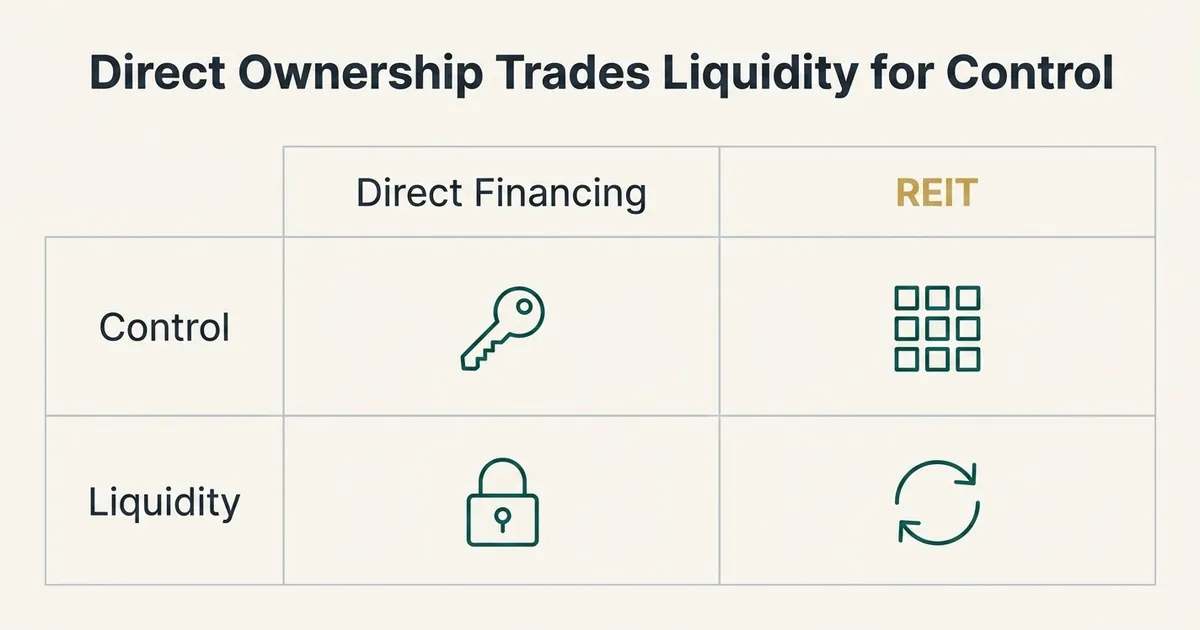
A $20,000 stake in a REIT or a fractional platform never triggers a debt-to-income calculation, a reserve requirement, or a personal guarantee, because you own shares of debt and equity that a professional operator already financed. IRS Publication 527 (2025) lets a direct owner deduct mortgage interest, depreciation, and operating expenses against rental income personally — a benefit a REIT shareholder doesn't get individually, since the REIT absorbs those deductions before distributing dividends that are largely taxed as ordinary income.
See REITs vs. rental properties for a full side-by-side of the yield and tax trade-offs, or whether fractional real estate is worth it if your check size is closer to $5,000 than $50,000. If you want the platforms themselves, best fractional real estate platforms ranks the current field by minimum investment and fee load.
What Mistakes Sink Investment Property Loan Applications?
The most common mistake is applying before a lease exists: without a signed lease or an appraiser's Form 1007 rent schedule, underwriters can't count any rental income toward your DTI, which sinks deals that would otherwise qualify. The second is underestimating landlord insurance cost; the Insurance Information Institute reports a landlord policy typically costs about 25% more than a homeowner's policy on the same property, and lenders build that higher premium into your qualifying PITI, not your original estimate.
The third mistake is ignoring local rental restrictions before closing. In California, the City of Los Angeles' Home-Sharing Ordinance (2024) requires a short-term-rental host permit and caps STR nights on non-primary residences, and several California lenders now confirm a building's rental restrictions before funding a condo purchase in that market. Check your target building's HOA rules and city ordinance before you go under contract, not after the loan is approved.
Disclaimer: This article explains general lending guidelines and is not individualized financial, tax, or legal advice; loan program terms, rates, and local rental rules change and vary by lender and jurisdiction, so verify current figures with your lender and your state's statutes before acting.
Frequently asked questions
Is it hard to get a loan for an investment property?
Getting approved is harder than for a primary residence but not unusual — the real barrier is cash, not paperwork. Lenders require 15%-25% down, a credit score generally above 680, and six months of PITIA reserves on the subject property according to Fannie Mae's Selling Guide B3-4.1-01; borrowers who clear those thresholds with a debt-to-income ratio under 45% typically close within the same 30-45 days as a standard home purchase.
What is the 7% rule for investment property?
There's no official "7% rule" in any Fannie Mae, Freddie Mac, or FHA guideline — it's an informal investor shorthand, sometimes used to mean that annual rent should equal at least 7% of the purchase price, a looser cousin of the more common 1% rule (monthly rent at 1% of price, or 12% annualized). Lenders don't use either heuristic: Fannie Mae's Selling Guide (2025) qualifies rental income at 75% of the lease or appraised market rent, while non-QM lenders size DSCR loans off a debt-service coverage ratio of 1.0-1.25, not a fixed percentage of the purchase price.
How do I avoid 20% down payment on investment property?
Three paths get you below 20%: an FHA or VA loan on a two-to-four-unit property where you occupy one unit, as low as 3.5% down under HUD's Handbook 4000.1 (2024); a cash-out refinance of your primary home to fund a down payment elsewhere; or skipping the loan entirely through a REIT, fractional platform, or syndication that requires no mortgage at all. Some non-QM lenders advertise 15% down on DSCR loans, but Fannie Mae's Loan-Level Price Adjustment matrix (2025) makes that pricing rare below a 700 credit score, so confirm the actual rate quote before you count on it.
What is the 50% rule in rental property?
The 50% rule estimates that operating expenses — property taxes, insurance, maintenance, vacancy, and management, excluding the mortgage — will consume about half of a rental's gross rent. No lender or trade body publishes it as a standard, and real operating-expense ratios vary widely with property age, region, and whether taxes and insurance are escrowed — which is why the rule works as a fast screen but understates costs on older buildings and overstates them on new construction. Build your own line-item estimate from actual local tax, insurance, and management quotes before trusting it.
What are investment property loans?
An investment property loan is any mortgage used to buy a property you don't live in and intend to rent for income, and it comes in five common forms: conventional agency loans, DSCR/non-QM loans, portfolio or bank-statement loans, hard-money/bridge loans, and FHA/VA loans on owner-occupied multi-unit buildings. According to the Urban Institute's Housing Finance Policy Center (2025), non-agency lenders now originate a growing share of investment-property loans as GSE pricing on investor deals has tightened since 2023.
What are current investment property loan rates?
Investment property loan rates run 0.5 to 0.75 percentage points above primary-residence rates on conventional loans, and 1-2 points above on DSCR or non-QM products. Freddie Mac's Primary Mortgage Market Survey put the average 30-year fixed primary-residence rate at 6.67% as of August 13, 2026, which puts a typical investment-property rate in roughly the 7.2%-7.4% range for a borrower with a 720+ credit score and 25% down. Rates move weekly, so confirm the current survey before relying on this figure.