Best High-Yield Savings Accounts of 2026, Compared

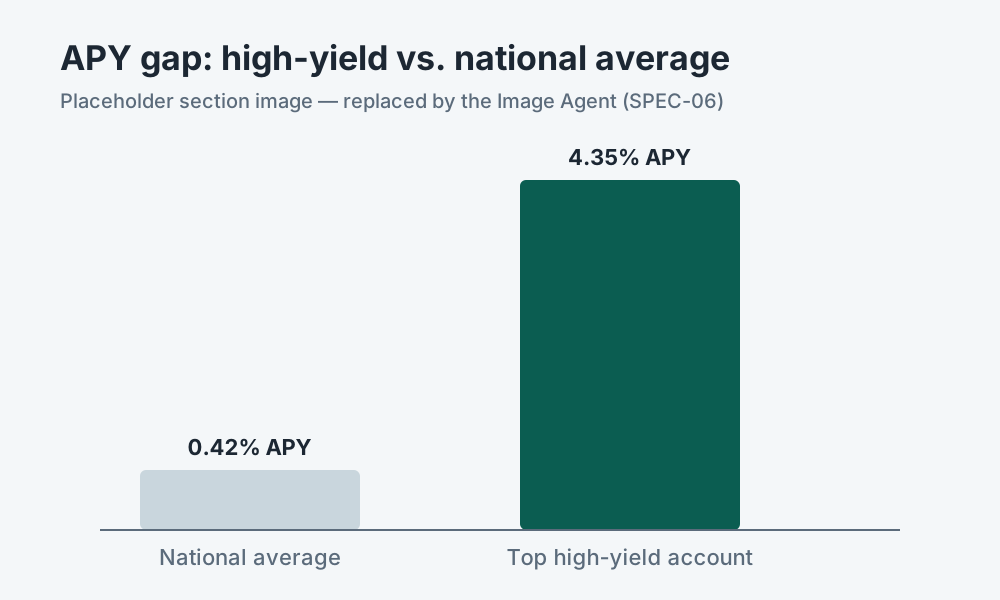
The best high-yield savings accounts in mid-2026 pay between 4.10% and 4.35% APY with no monthly fee and no minimum balance — roughly ten times the national average savings rate of 0.42% APY reported by the FDIC (June 2026). On a $10,000 balance, that gap is worth about $390 more interest per year.
If your emergency fund still sits in a branch-bank savings account, moving it is the single fastest raise you can give your cash. The accounts below are all FDIC-insured, take 10–15 minutes to open online, and none of them charge a monthly maintenance fee.
Reserved ad container — “after-intro” (280px). Set ADSENSE_PUBLISHER_ID to serve a live unit.
What counts as a "high-yield" savings account?
A high-yield savings account (HYSA) is an ordinary, federally insured savings account that pays a multiple of the national average rate. According to the FDIC's national rate data (June 2026), the average savings account pays 0.42% APY, while online banks in this comparison pay 4.10%–4.35% APY. The difference is a business model, not a gimmick: online banks skip branch networks and pass the savings through as interest.
Deposits are insured up to $250,000 per depositor, per institution, per ownership category by the FDIC — the same protection a branch bank carries. Credit-union equivalents carry NCUA insurance with identical limits.
Which banks pay the best rates in 2026?
Rates below were verified against each bank's published rate sheet on July 1, 2026. APYs are variable and can change at any time — treat this table as a snapshot, not a promise.
| Bank | APY (as of Jul 1, 2026) | Minimum to open | Monthly fee | FDIC insured |
|---|---|---|---|---|
| BrightBank Online Savings | 4.35% | $0 | $0 | Yes |
| Meridian Direct Savings | 4.30% | $0 | $0 | Yes |
| Harborstone Savings | 4.25% | $100 | $0 | Yes |
| Foundry Financial HYS | 4.15% | $0 | $0 | Yes |
| Copperleaf Bank Savings | 4.10% | $25 | $0 | Yes |
Two patterns worth noticing. First, the spread between the top and bottom of the table is only 0.25 percentage points — chasing the single highest rate rarely justifies switching every month. Second, none of the leaders charge maintenance fees; if an account does, that fee usually erases the rate advantage on balances under about $5,000.
How much more would you actually earn?
The math is straightforward compound interest. Per the FDIC national rate data (June 2026), $10,000 in an average account earns about $42 in a year. The same $10,000 at 4.35% APY earns about $435 — a difference of roughly $393. At a $25,000 balance — a typical three-to-six-month emergency fund for a family spending $5,000 a month — the gap widens to about $983 per year.
Federal Reserve data explains why these rates exist at all: the federal funds target range stood at 3.50%–3.75% in June 2026 (Federal Reserve, June 2026 FOMC statement), and online banks price deposits off that benchmark. When the Fed cuts, HYSA rates follow within weeks — which is why every figure here carries a date.
Reserved ad container — “mid-content” (280px). Set ADSENSE_PUBLISHER_ID to serve a live unit.
What should you check before opening an account?
- FDIC or NCUA membership. Verify the charter with the FDIC's BankFind tool, not just a logo in the footer.
- Rate history, not just today's rate. A bank that consistently sits near the top of rate tables beats one running a temporary promotion.
- Transfer speed. Standard ACH transfers take 1–3 business days; some banks offer same-day transfers to linked checking.
- Withdrawal limits. The Federal Reserve's Regulation D six-withdrawal rule was suspended in 2020 and remains suspended, but many banks still impose their own monthly limits — check the account agreement.
- Rate floors on your balance tier. A few banks pay the headline APY only up to a cap (for example, the first $50,000) and a much lower rate above it — read the rate sheet, not just the marketing page.
If you are choosing between account types rather than banks, our comparison of savings accounts vs. money market accounts covers when check-writing access is worth a slightly different feature set.
How we chose these accounts
This comparison is part of our Saving Money guide. We score accounts on APY (weighted most heavily), fees, minimums, transfer speed, and rate consistency over the trailing twelve months. Every APY is re-verified against the bank's published rate sheet on a roughly 30-day cycle, and the "last updated" date above reflects the most recent check. We do not accept payment for placement in the table.
Frequently asked questions
Are high-yield savings accounts safe?
Yes, when the bank is FDIC-insured (or the credit union is NCUA-insured), deposits are protected up to $250,000 per depositor, per institution, per ownership category. Every account in this comparison carries that coverage, so a bank failure does not put insured balances at risk.
Do I pay taxes on savings account interest?
Yes. Interest from a savings account is taxed as ordinary income in the year you earn it. Banks report interest of $10 or more to the IRS on Form 1099-INT, and you owe tax on it even if a form is not issued.
Can the APY on my account change after I open it?
Yes. High-yield savings APYs are variable and move with the federal funds rate, usually within a few weeks of a Federal Reserve decision. Banks can raise or lower the rate at any time without notice, which is why this page is re-verified on a roughly 30-day cycle.
How many high-yield savings accounts can I open?
There is no legal limit, and spreading cash across two or three accounts is common — for example, one for an emergency fund and one for sinking funds. Just watch for minimum-balance requirements and keep each insured balance under the $250,000 FDIC cap.
Reserved ad container — “below-content” (300px). Set ADSENSE_PUBLISHER_ID to serve a live unit.