Cash Management Account vs HYSA: Which Wins in 2026?

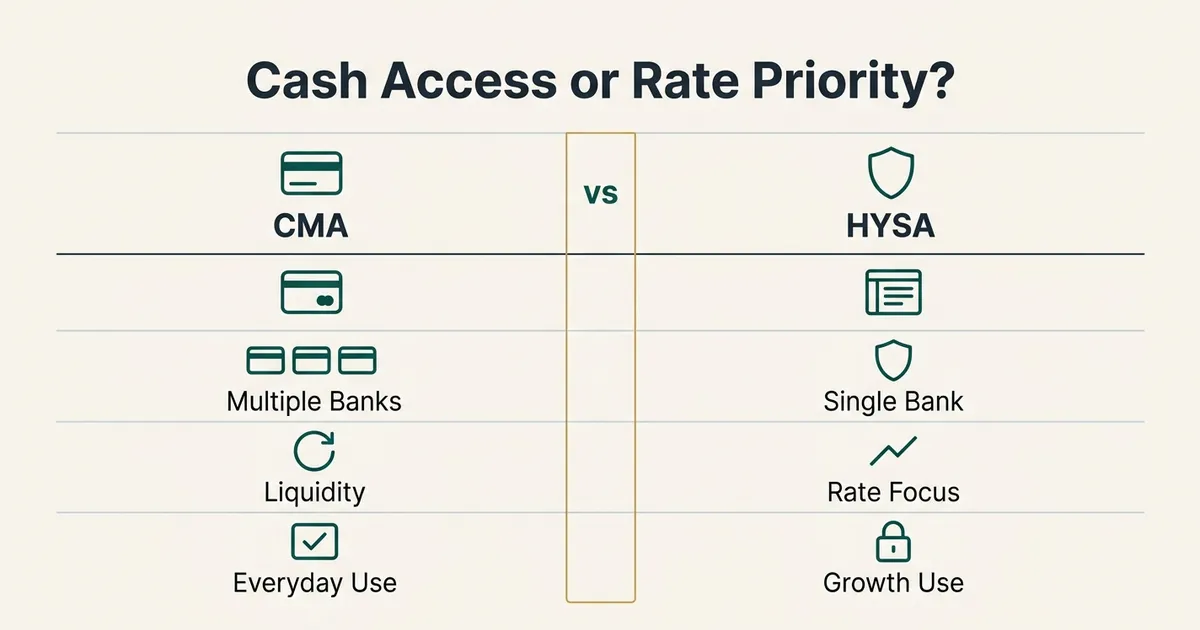
A cash management account (CMA) blends debit-card access with FDIC coverage spread across multiple partner banks. A high-yield savings account (HYSA) usually pays a higher stated APY on the same balance, so choose the CMA for spending flexibility and multi-bank insurance, and the HYSA for maximizing yield on cash you won't touch for months.
Both accounts are cash, not investments, so principal doesn't fluctuate with the stock market the way it would in a brokerage account. According to the FDIC (2024), standard deposit insurance covers $250,000 per depositor, per insured bank, per ownership category, and a CMA's sweep structure can multiply that protection by spreading your balance across several partner banks. For the full picture of where to park short-term family cash, see our pillar guide to saving money in cash and deposit accounts.
How Does a Cash Management Account Work?
A cash management account is a brokerage- or fintech-held account that sweeps your uninvested cash into one or more FDIC-insured partner banks overnight, then rebalances it the next business day based on each bank's capacity. The sweep exists because the CMA provider itself is usually not a bank — it's a broker-dealer or registered investment adviser — so it needs bank partners to hold deposits under insurance rules that only apply to banks and credit unions, per the FDIC (2024).
According to Fidelity (2026), its Cash Management Account sweeps balances across a network of program banks, extending FDIC coverage to as much as $4 million — many times the standard $250,000 single-bank limit. According to Wealthfront (2026), its Cash Account uses a larger partner-bank network to advertise coverage up to $8 million for an individual account and $16 million for a joint account, though the exact multiplier shifts as banks join or leave the network.
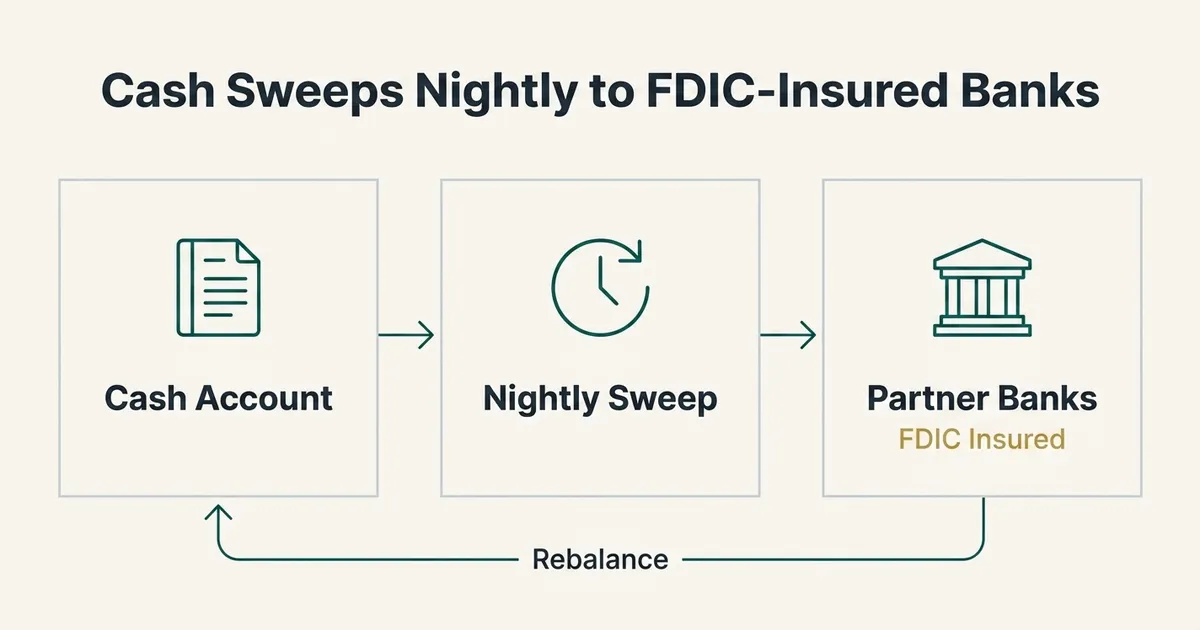
Most CMAs bundle a debit card, mobile check deposit, bill pay, and out-of-network ATM fee reimbursement — features a typical HYSA skips because it's built for saving, not spending. The trade-off is rate: CMA sweep yields are often blended, meaning the provider keeps a cut before passing along what partner banks actually pay, per FINRA (2024) guidance on broker-dealer cash sweep disclosures.
Cash Management Account vs HYSA: What's the Difference?
According to Bankrate (August 2026), nationally available HYSAs advertised top APYs between 4.00% and 4.50%, while brokerage CMAs' default sweep yields more often landed between 2.50% and 4.00% because providers retain a spread. Insurance mechanics differ too: a HYSA sits directly at one bank under the standard $250,000 limit, while a CMA's sweep can push effective coverage into seven figures depending on how many partner banks the provider uses.
| Feature | Cash Management Account | High-Yield Savings Account |
|---|---|---|
| Typical APY (Bankrate, Aug. 2026) | 2.50%–4.00%, blended after provider spread | 4.00%–4.50%, top nationally available |
| FDIC insurance mechanism | Pass-through via sweep to 1–40+ partner banks | Direct at one bank, $250,000 standard limit |
| Debit card / paper checks | Standard on most accounts | Rare; usually transfer-only |
| Monthly withdrawal limit | None (Regulation D cap removed, Federal Reserve, April 2020) | None (Regulation D cap removed, Federal Reserve, April 2020) |
| Typical minimum balance | Often $0 | Often $0–$100 |
| Outgoing wire fee | $15–$30 common | Often $0–$25, varies by bank |
| Best for | Spending and saving from one balance | Maximizing rate on cash you won't touch |
The table's trade-off comes down to one line: a HYSA usually wins on rate, a CMA usually wins on access. A parent who wants a single account that pays bills, holds an emergency fund, and never triggers a transfer delay should accept the lower CMA yield; a parent who already banks with a separate checking account and just wants the emergency fund to earn the most possible should move it to a HYSA and transfer funds as needed, since Regulation DD — enforced by the Consumer Financial Protection Bureau (2023) — requires providers to disclose current APY and transfer terms in the account agreement before you open it. If you decide the HYSA slice wins, our step-by-step guide on how to open a high-yield savings account walks through minimums and transfer speed by provider. If you're also weighing a money market account against a plain savings account, see the full HYSA vs. money market account comparison.
Which Account Wins for a Parent's Emergency Fund?
Run the numbers before picking a side. On a $20,000 cushion — roughly four months of a $5,000 essential-expense budget — a HYSA paying 4.30% APY earns about $860 a year, while a CMA's blended 3.00% APY earns about $600, a gap of roughly $260 a year; this comparison is illustrative, since actual APYs move with the rate environment and aren't guaranteed. That $260 buys you nothing extra in a HYSA — it's pure opportunity cost you accept for the CMA's debit card, bill pay, and check-writing built into the same balance.
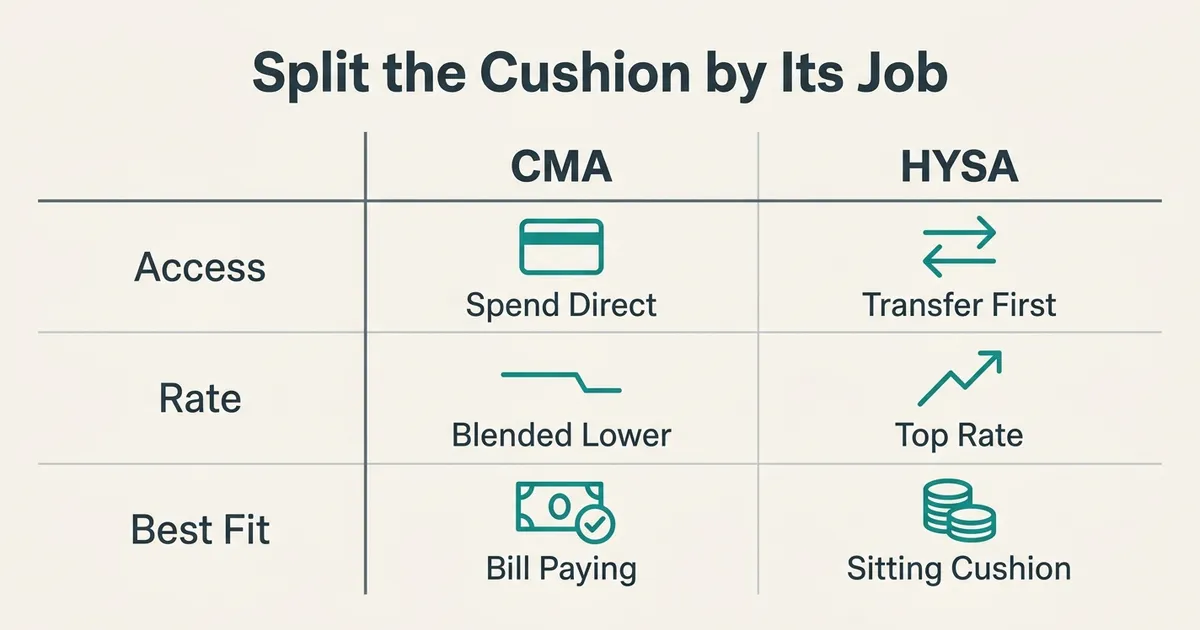
Choose a CMA if you want to run household bill pay and debit spending out of the same balance that holds your 3-to-6-month cushion, and you're willing to give up 50 to 150 basis points of yield for that convenience. Choose a HYSA if you keep a separate checking account for spending and only need this money to sit and grow until an emergency hits. Don't rely on either alone once a balance clears $250,000 without confirming your coverage: a single-bank HYSA holding $400,000 needs a second bank, a joint titling change, or a CMA's multi-bank sweep to stay fully insured under FDIC (2024) ownership-category rules.
Split the cushion by time horizon instead of parking it all in one product. Keep one month of expenses in a checking-linked CMA for instant bill pay, put the next two to three months in a HYSA for the best liquid rate, and consider laddering the final one to two months into short CDs if you're confident you won't need that slice for 3 to 12 months — see our guide on how to build a CD ladder for the mechanics. A money market account can substitute for the HYSA slice if you want check-writing on the higher-yield portion too.
What Are the Disadvantages of a Cash Management Account?
The biggest disadvantage is yield: providers keep a spread between what partner banks pay and what they credit you, so a CMA's blended APY often trails a top HYSA by 50 to 150 basis points, according to the SEC (2023) disclosures on broker-dealer cash sweep programs. Because the provider — not you — chooses which partner banks hold your money, your effective FDIC coverage can shift when a bank leaves the network, and you're responsible for confirming your total balance still sits under $250,000 at each institution, per the FDIC (2024).
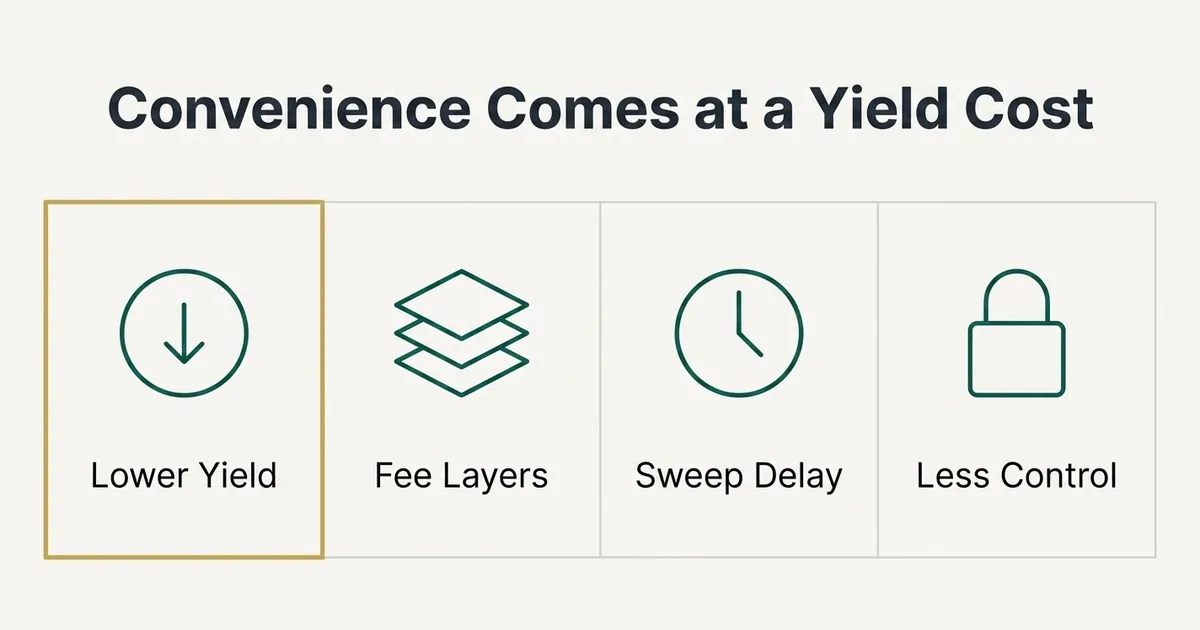
Fintech-branded CMAs — ones not run by a bank or broker-dealer directly — add a layer of risk: FDIC insurance applies to the partner bank, not the fintech brand, and if the fintech itself fails before funds are swept, the timeline for recovering that cash can stretch, according to the CFPB (2024) guidance on bank-partnership disclosures. Most CMAs charge $0 for debit and standard ACH but still bill $15 to $30 for outgoing domestic wires, and none accept over-the-counter cash deposits since they operate with no physical branches.
Is a Cash Management Account FDIC-Insured, and How Much Coverage Do You Get?
Yes — a CMA's cash sits at FDIC-insured partner banks, not at the brokerage itself, and coverage follows the same $250,000-per-owner, per-bank rule that applies to any deposit account, according to the FDIC (2024). A married couple with a joint CMA can hold up to $500,000 fully insured at a single partner bank because joint accounts get their own $250,000-per-co-owner category, separate from each spouse's individual holdings at that same bank, per FDIC (2024) ownership-category rules.
Multi-bank sweep networks exist specifically to push coverage past that single-bank ceiling without you opening separate accounts yourself. If a family's CMA sweeps $600,000 of home-sale proceeds across four $150,000 slices at four program banks, the full balance stays insured because no single bank holds more than $250,000 of it — an illustration of the mechanism, not a promised allocation for every provider. Regulation DD, enforced through the Consumer Financial Protection Bureau (2023), requires the provider to disclose the current APY and any tiered-rate thresholds in the account agreement, so read that disclosure before assuming an advertised rate applies to your entire balance.
This article explains how these accounts generally work; confirm current APYs, fee schedules, and FDIC coverage directly with each provider before moving a family emergency fund.
Frequently asked questions
What are the disadvantages of a cash management account?
The main disadvantage is a lower blended yield: providers keep a spread between what partner banks pay and what they credit account holders, so CMAs often trail top HYSAs by 50 to 150 basis points, according to the SEC (2023) disclosures on broker-dealer cash sweep programs. A second disadvantage is indirect insurance — your money sits at a partner bank the provider chooses, not one you select, so you must track which banks hold your funds to confirm you stay under the FDIC (2024) $250,000-per-bank limit. CMAs also typically charge $15 to $30 for outgoing wires and don't accept over-the-counter cash deposits since most operate with no physical branches.
How does a cash management account work?
A cash management account sweeps uninvested cash out of the brokerage or fintech platform and into one or more FDIC-insured partner banks, usually overnight, then reports the combined balance back as a single number. The provider is typically a broker-dealer or registered investment adviser rather than a bank itself, so it relies on these bank partnerships to make deposit insurance apply, per the FDIC (2024) rules on pass-through insurance. Interest accrues daily on the swept balance and is credited monthly, and the debit card, checks, and bill pay draw against that same swept cash the next business day.
Who has the best cash management account?
There's no single best cash management account for every family — the right pick depends on how much FDIC coverage you need and whether you want checks, a debit card, or ATM fee reimbursement bundled in. According to Fidelity (2026), its Cash Management Account extends FDIC coverage up to $4 million by sweeping across a network of program banks and reimburses ATM fees nationwide, which suits families who want spending features. According to Wealthfront (2026), its Cash Account uses a larger partner-bank network advertising coverage up to $8 million for an individual account, which suits families parking a larger lump sum, such as home-sale proceeds, who don't need a debit card.
Can you withdraw money from a CMA account?
Yes — federal Regulation D no longer limits withdrawals from savings-type deposit accounts, a change the Federal Reserve (April 2020) made permanent, so CMAs impose no federal cap on monthly withdrawals. Most CMAs let you withdraw through a linked debit card, ATM, check, or ACH transfer, typically within one to three business days for ACH and instantly for debit or ATM use. Some providers still apply their own daily debit or ATM withdrawal caps, commonly $500 to $2,500 per day, so check the account agreement if you need a larger same-day withdrawal.
How does Fidelity's cash management account work?
Fidelity's Cash Management Account is a brokerage account, not a bank account, that sweeps uninvested cash into a network of program banks rather than holding it directly. According to Fidelity (2026), the sweep spreads balances across a network of program banks, extending FDIC insurance to as much as $4 million — many times the standard $250,000 single-bank limit. The account includes a debit card, nationwide ATM fee reimbursement, and mobile check deposit, but its default sweep yield has historically trailed top nationally advertised HYSAs, so families chasing the single highest rate should compare both before parking a full emergency fund there.
Cash management account vs. high-yield savings account: which pays more?
A high-yield savings account usually pays more: according to Bankrate (August 2026), nationally available HYSAs advertised top APYs of roughly 4.00% to 4.50%, while brokerage CMAs' default sweep yields more often landed between 2.50% and 4.00% because providers retain part of the spread. On a $20,000 emergency fund, that gap is illustrative but real — the difference between 4.30% and 3.00% APY works out to roughly $260 a year, money the CMA gives up in exchange for built-in debit and check access. Families who keep a separate checking account for spending should generally hold the bulk of an emergency fund in the higher-paying HYSA and use a CMA only for the slice they need to spend directly.