Brokerage Account for Kids: Custodial Guide (2026)

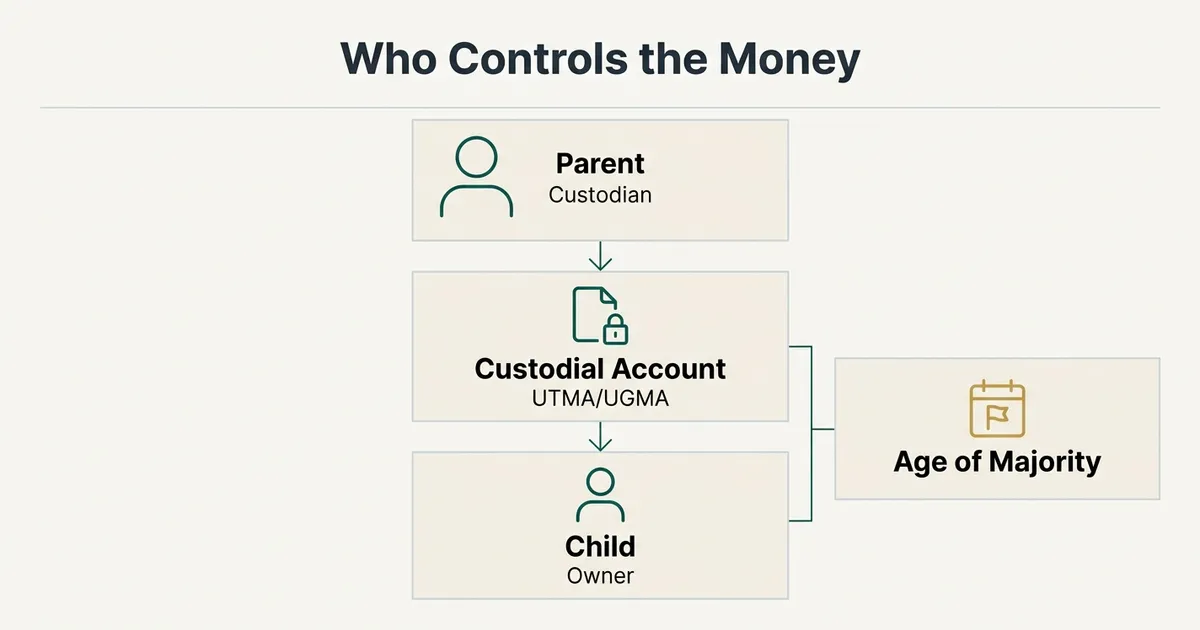
A brokerage account for kids is a custodial UTMA or UGMA account that lets a parent invest for a minor until the child reaches the state's age of majority. Parents fund it, select the investments, and the money legally belongs to the child the moment it's deposited — even though the parent manages it as custodian.
Every dollar you put into the account is an irrevocable gift under state law, not a loan you can pull back if plans change. According to the U.S. Securities and Exchange Commission's Investor.gov (2024), a custodial account under the Uniform Transfers to Minors Act (UTMA) or the older Uniform Gifts to Minors Act (UGMA) requires the custodian to manage assets solely for the minor's benefit — you can't redirect the funds to pay your own rent or a sibling's tuition.
What Is a Brokerage Account for Kids?
A brokerage account for kids is a custodial account opened at a licensed broker-dealer that holds cash and securities — stocks, bonds, ETFs, mutual funds — on behalf of a minor. According to the Financial Industry Regulatory Authority (2025), brokerage firms opening custodial accounts must register the account under the child's Social Security number, with an adult custodian (usually a parent or grandparent) making all trading decisions until the child reaches the age of majority.
This differs from a 529 plan or a savings account in one important way: the money is invested in the market, not held as cash or restricted to education spending. That's what makes it the right tool for building passive dividend income — recurring cash payments companies distribute to shareholders — rather than just parking savings.
How Does a Custodial Brokerage Account Actually Work?
You open the account under your name as custodian and the child's name as beneficiary, fund it by transfer or recurring deposit, and choose the investments — the child cannot legally direct trades until they reach majority. The custodian has a fiduciary duty, meaning you must manage the assets prudently and only for the child's benefit, a legal standard set by each state's version of the UTMA. Which of the two acts governs your account depends on the state, and it changes what you can hold and when the child takes control — UTMA vs UGMA lays out the differences.
The mechanism that makes this powerful for dividend investing is automatic reinvestment. When a stock or ETF you hold pays a dividend, the broker can automatically use that cash to buy additional fractional shares through a dividend reinvestment plan (DRIP) — no manual trade required. According to FINRA (2025), DRIPs let investors compound returns by continuously increasing share count without paying separate commissions, since most major brokers now execute DRIP trades commission-free.
The catch parents miss: once money goes into the account, it's an irrevocable gift under the applicable state UTMA/UGMA statute. You cannot "borrow it back" for a family emergency, and the IRS treats the transfer as a completed gift for gift-tax purposes the moment it's deposited — not when the child eventually withdraws it.
Which Account Type Fits Your Family: UTMA/UGMA, 529, or Custodial Roth IRA?
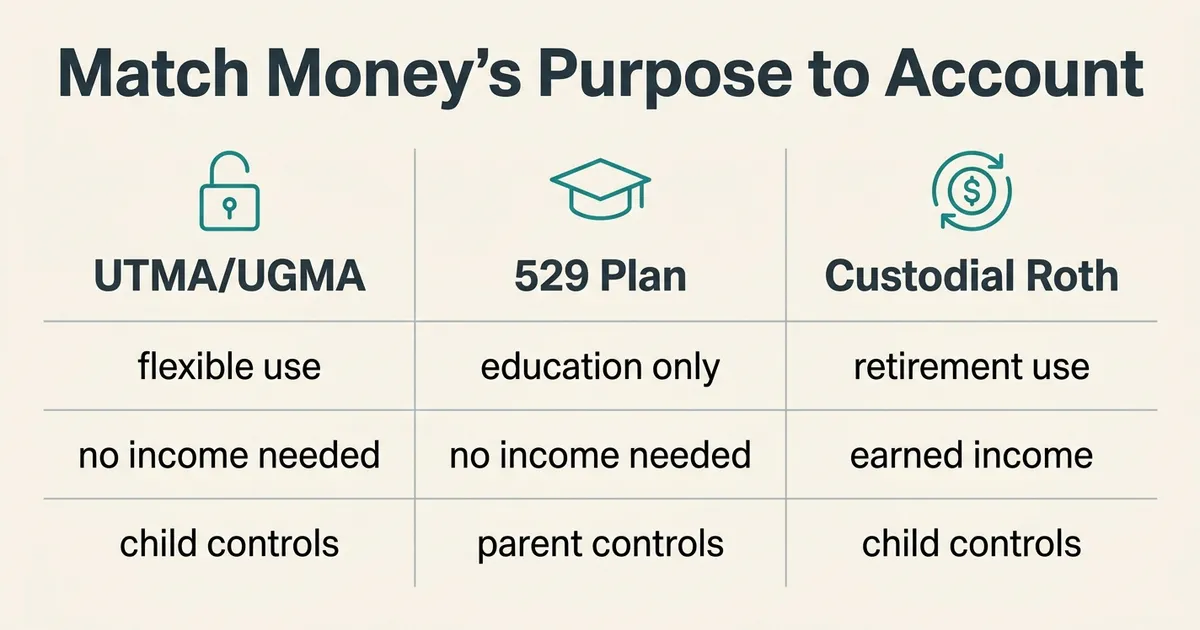
The right account depends on whether the money needs to stay flexible, must fund education, or is tied to the child's own earned income. Use the table below to match your situation to the account before you open anything.
| Feature | UTMA/UGMA Custodial Brokerage | 529 College Savings Plan | Custodial Roth IRA |
|---|---|---|---|
| Who can contribute | Anyone, no earned-income requirement | Anyone, no earned-income requirement | Only up to the child's own documented earned income |
| Annual gift-tax-free limit | $19,000 per donor in 2026, adjusted yearly (IRS Rev. Proc. 2025-32) | $19,000 per donor, or $95,000 with 5-year election (IRS Rev. Proc. 2025-32) | Lesser of earned income or the annual IRS Roth limit — $7,500 for 2026 (IRS Notice 2025-67) |
| Tax treatment of growth | Kiddie tax applies: first $1,350 tax-free, next $1,350 at child's rate, above $2,700 at parent's rate for 2026 (IRS Revenue Procedure 2025-32, 2025) | Grows tax-free federally if used for qualified education expenses (IRC §529) | Grows tax-free if withdrawn after age 59½ with the account open 5+ years |
| Who controls it | Custodian until age of majority — 18 in California by default, extendable to 21 for an irrevocable gift if specified at funding (Cal. Probate Code §3920.5) | The account owner (usually the parent), indefinitely | Child owns it permanently; custodian manages only until majority |
| Use restrictions | None — funds can be used for any purpose once transferred | Education, apprenticeship programs, and up to $20,000 a year in K-12 expenses from 2026 under the OBBBA (double the prior $10,000, and no longer tuition-only); non-qualified withdrawals owe tax plus a 10% penalty on earnings | Contributions withdrawable anytime penalty-free; earnings withdrawn early face tax plus a 10% penalty |
| Best for | Flexible dividend investing and general wealth-building | Locking in college savings with a state tax break | Kids with real earned income (modeling, tutoring, a small business) wanting decades of tax-free growth |
Choose the UTMA/UGMA custodial brokerage account if you want flexibility — the money can pay for a car, a first apartment, or extracurriculars, not just tuition. Choose a 529 if college costs are the near-certain goal and you want a state income-tax deduction along the way; compare the two directly in this custodial account vs. 529 plan breakdown. Choose a custodial Roth IRA only if your child has provable W-2 or self-employment income — the IRS requires earned income to fund it, so allowance money doesn't qualify.
How Much Should You Invest Each Month to Build Real Dividend Income?
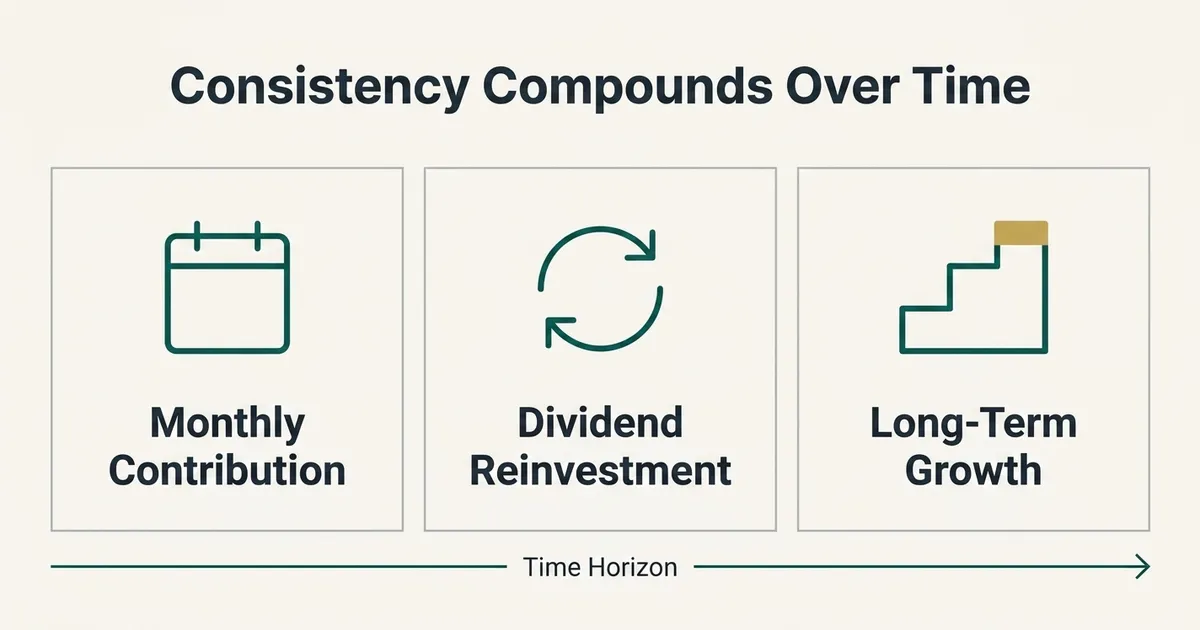
Even $50 a month builds a meaningful account by the time a young child reaches their teens, because dividend reinvestment compounds monthly contributions on top of monthly compounding. Using a hypothetical 7% average annual return — a conservative blend consistent with long-run diversified stock returns — $50 a month for 10 years grows to roughly $8,660 from $6,000 in contributions, an illustrative gain of about $2,660.
At $200 a month over the same 10 years, the same 7% assumption produces about $34,640 from $24,000 contributed, a gain near $10,640. At $500 a month, it's about $86,600 from $60,000 contributed — a gain around $26,600. These are hypothetical projections, not promised outcomes; actual returns swing with market performance in any given year.
According to Morningstar (2025), the S&P 500 has delivered an average annualized total return near 10% since 1926, but individual decades have ranged from deeply negative to over 15%, which is why financial planners typically model long-horizon child accounts at a more conservative 6%-8% rather than the historical average. Set your monthly amount as an automatic transfer on the same day your paycheck lands — brokers like Fidelity, Schwab, and Vanguard all support recurring automatic investments into custodial accounts at no added cost.
What Should You Buy Inside the Account for Passive Dividend Income?
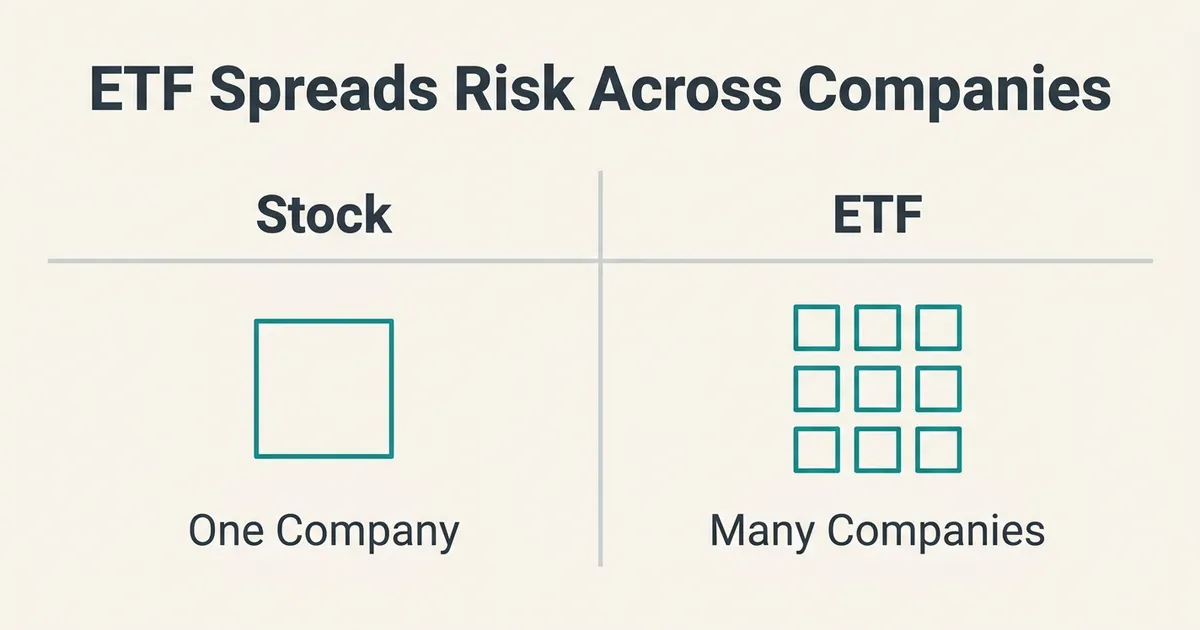
For a child's account with a 10-15 year horizon, a low-cost dividend ETF is the default choice over individual stocks because it spreads risk across dozens of companies instead of betting on one. The Schwab U.S. Dividend Equity ETF (SCHD), for example, paid $1.05 a share over the trailing 12 months for a dividend yield near 3.0% (stockanalysis.com, August 2026), distributed quarterly to shareholders and available for automatic reinvestment at most brokers. Yields move with price and payout, so check the fund's current figure before you rely on it.
A $10,000 position in a fund yielding 3.0% generates about $300 a year in dividends before reinvestment — money that buys more shares automatically rather than sitting in cash. Individual dividend stocks can outperform a fund, but they concentrate risk in one company's earnings and dividend policy; a single dividend cut (like several major banks made in 2020) can stall an entire custodial account's income stream. Compare the trade-offs in depth in this guide to dividend ETFs vs. individual stocks, and see specific fund and stock picks screened for custodial accounts in the best dividend stocks for a custodial account.
Turn on automatic dividend reinvestment the same day you fund the account — most brokers default new custodial accounts to cash dividends unless you actively select DRIP in account settings. Walk through the exact settings screens in this DRIP auto-compounding setup guide so you're not leaving a dividend sitting uninvested for a full quarter.
How Are Dividends Taxed Under the Kiddie Tax Rules?
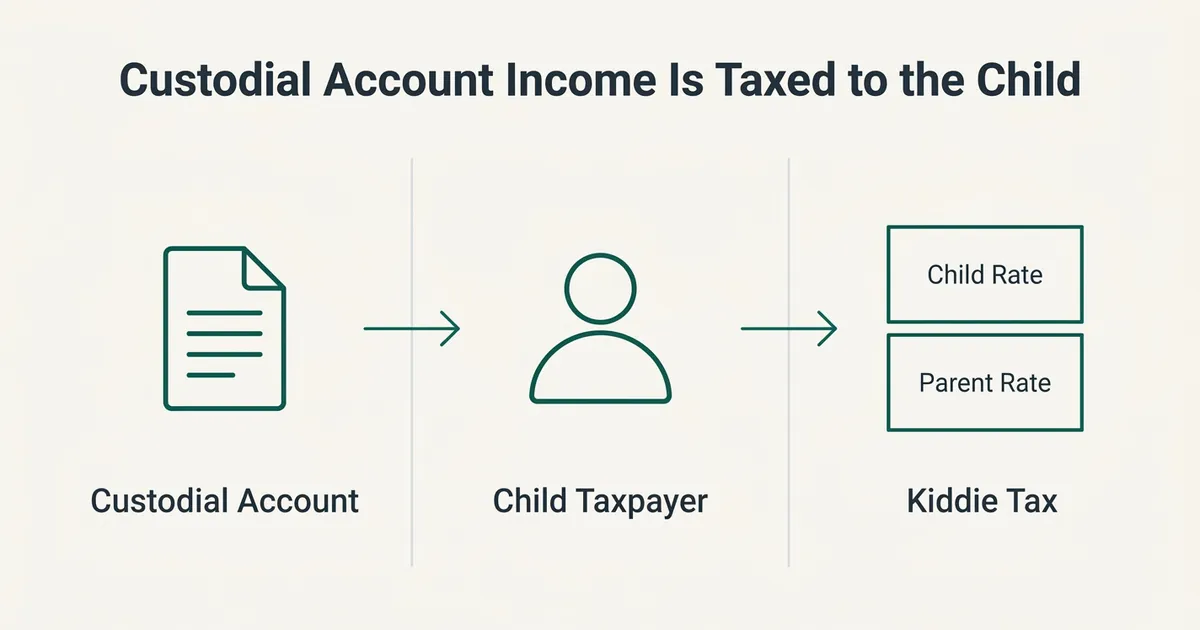
Dividends and capital gains inside a custodial account are taxed to the child under the "kiddie tax," not automatically at your own income tax rate. For tax year 2026, the first $1,350 of a child's unearned income is tax-free, the next $1,350 is taxed at the child's own rate, and anything above $2,700 is taxed at the parent's marginal rate, according to the IRS (Revenue Procedure 2025-32, 2025) — these thresholds adjust for inflation annually and happen to be unchanged from 2025, so confirm the current figures in the Form 8615 instructions before filing.
The kiddie tax applies only to unearned income — dividends, interest, and capital gains — not to a teenager's wages from an actual job, per the IRS (2025). If the child's unearned income exceeds the $2,700 threshold, you generally file Form 8615 with the child's own tax return; if it's under $13,500 for 2026, you may instead elect to report it on your own return using Form 8814, according to the IRS (2026) — though that election can push your own return into a higher bracket, so run both scenarios before choosing.
Qualified dividends — those paid by most U.S. corporations held more than 60 days — get preferential rates of 0%, 15%, or 20% depending on total taxable income, per IRS Publication 550 (2025). Because most custodial accounts sit well under the higher brackets in the early years, dividends inside a young child's account are frequently taxed at 0% federally — one of the strongest arguments for starting the account early rather than waiting.
Who Controls the Money — and When Does Your Child Take Over?
The custodian controls all investment decisions until the child reaches the state's age of majority, at which point full legal control transfers automatically — you cannot delay it once that birthday arrives. In California, the default UTMA age of majority is 18, and Cal. Probate Code §3920.5 lets the person funding the account specify a later age at the time of the transfer — but for an outright irrevocable gift, which is exactly what funding a custodial brokerage account is, the ceiling is 21. The age-25 option in that same section applies only to custodial property transferred by a trustee or under a will or trust, so a parent writing a check cannot reach it.
Other states set different defaults — some UGMA states transfer control at 18 with no extension option, while several UTMA states allow custodians to elect ages up to 21 or 25; verify your specific state's statute before assuming California's rules apply. Once your child reaches that age, they can legally withdraw and spend the entire balance on anything — a car, tuition, or nothing at all — regardless of your original intent for the money.
This irrevocability cuts both ways for financial aid too. Because the assets legally belong to the child, the FAFSA methodology weighs student-owned assets more heavily than parent-owned assets — up to 20% of a custodial account's value counts toward the Student Aid Index (SAI) — the figure that replaced the Expected Family Contribution starting with the 2024-25 FAFSA — versus a maximum 5.64% for parent-owned assets, according to the U.S. Department of Education's Federal Student Aid 2026-27 Handbook. Families expecting to apply for need-based aid should weigh a 529 plan — which counts as a parental asset — against a custodial brokerage account for this reason; the custodial account vs. 529 plan comparison walks through the math.
What Are the Biggest Mistakes Parents Make With Custodial Accounts?
The most common mistake is assuming you can move the money back into your own account or a sibling's account later — you legally can't, because the gift is irrevocable the moment it's deposited. The second is skipping the kiddie tax filing once unearned income crosses the $2,700 threshold for 2026 (IRS Revenue Procedure 2025-32, 2025); the IRS can assess penalties and interest on unfiled Form 8615 returns years after the fact.
The third mistake is leaving dividends set to cash instead of DRIP, which silently drags down long-term compounding — a $200/month account that leaves a 3% dividend yield sitting as uninvested cash instead of reinvesting it loses a meaningful share of the 10-year growth shown earlier. The fourth is over-funding a single custodial account past the $19,000-per-donor annual gift exclusion for 2026 (IRS Rev. Proc. 2025-32) without realizing amounts above that require filing Form 709, even though no tax is typically owed until you exhaust the lifetime exemption.
The fifth, and most overlooked, is picking individual growth stocks with no dividend at all inside a young child's account, then having nothing to reinvest and no income stream to point to when explaining compounding to a curious 8-year-old. Build the whole strategy at the pillar level — see Family Dividend Investing for how account selection, holdings, and taxes fit together as one system rather than three separate decisions.
Contributions and account features described above reflect rules in effect as of August 2026 and are illustrative, not individualized financial or tax advice; confirm current thresholds with the IRS and your state's statute before opening or funding an account.
Frequently asked questions
Is putting money in a brokerage account a good idea?
Yes, for money you don't need for at least 3-5 years, because market-invested funds have historically outgrown cash savings by a wide margin over that horizon. According to the FDIC (2026), the national average savings account yield was 0.38% APY as of August 17, 2026, while according to Morningstar (2025), the S&P 500 has averaged roughly 10% annualized since 1926 — though that stock return is far more volatile year to year and isn't guaranteed for any single period.
What if I invest $1,000 a month for 5 years?
Investing $1,000 a month for 5 years means contributing $60,000 total, which grows to roughly $71,600 under a hypothetical 7% average annual return, an illustrative gain near $11,600. That 7% assumption is a conservative planning figure below the S&P 500's roughly 10% long-run average cited by Morningstar (2025); actual results depend entirely on market performance and could be higher or lower in any real five-year window.
Is it better to have a 401(k) or a brokerage account?
For a working adult, a 401(k) usually wins first because of the employer match and pre-tax contribution limit of $24,500 for 2026 (IRS Notice 2025-67), which a taxable brokerage account can't replicate. For a minor without earned income, a 401(k) isn't available at all — kids can only access tax-advantaged retirement accounts like a custodial Roth IRA if they have documented earned income, which is why a custodial brokerage account is the default starting point for most families with young children.
What does a brokerage account do?
A brokerage account holds cash and securities and executes buy and sell orders you or your broker place, acting as the intermediary between you and the stock exchanges. According to FINRA (2025), brokerage firms must be registered broker-dealers that route your trades to exchanges like the NYSE or Nasdaq, hold your securities in custody, and report your dividends, interest, and gains to the IRS each year on Form 1099.
What does "brokerage account" mean?
A brokerage account is a financial account opened at a licensed brokerage firm that lets an investor buy, hold, and sell securities such as stocks, bonds, ETFs, and mutual funds. According to the SEC's Investor.gov (2024), brokerage accounts are distinct from bank deposit accounts because the assets inside are investments, not cash, and their value fluctuates with the market rather than earning a fixed rate.
What is a brokerage account calculator?
A brokerage account calculator is a tool that projects an account's future value based on a starting balance, a recurring monthly contribution, an assumed annual return, and a time horizon. Investor.gov, run by the SEC (2025), publishes a free compound interest calculator that lets parents model scenarios like $200 a month for 10 years at a chosen return rate to see contributions versus projected growth side by side — useful for comparing account strategies before you commit to one.