Dividend Income: How Much to Invest (2026 Guide)

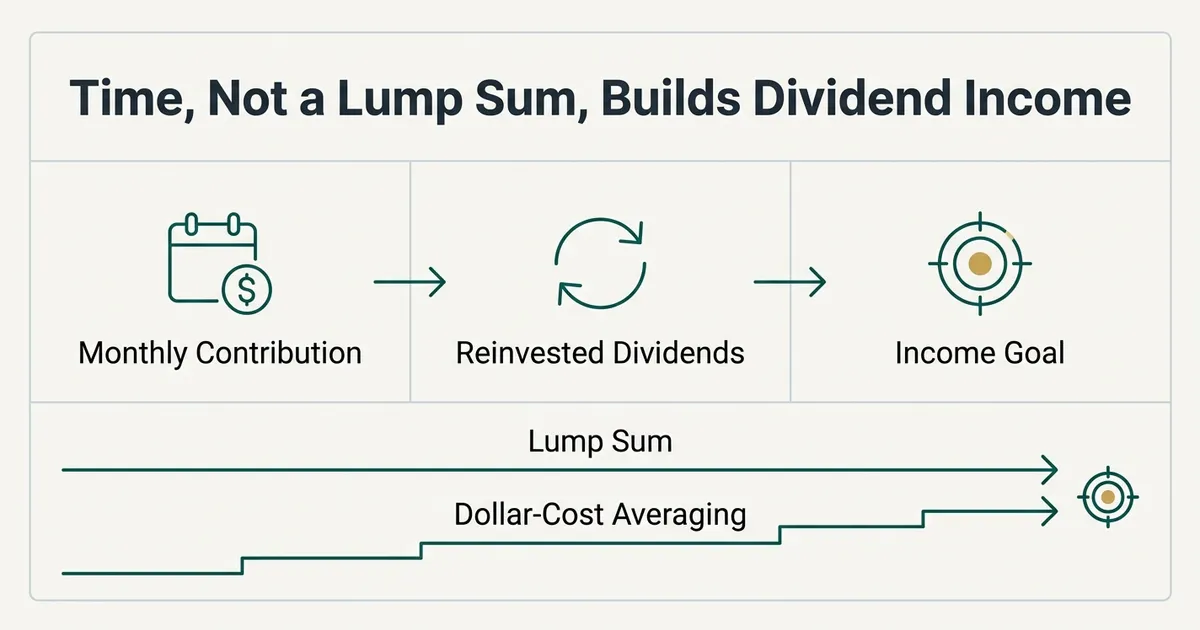
To generate $1,200 a year in dividend income, you typically need $30,000 to $48,000 invested at a 2.5%-4% average yield. For a child's custodial account funded with $50-$200 a month, that dividend income builds over 8-15 years through reinvested dividends and dollar-cost averaging, not a single lump-sum deposit.
This calculation scales in a straight line: doubling the monthly dividend income you want roughly doubles the principal required at the same yield, and the exact number shifts with the average yield of the stocks or ETFs you hold. According to Hartford Funds ("The Power of Dividends: Past, Present, and Future," 2026), dividend income's contribution to the total return of the S&P 500 Index averaged 33% from 1940-2025, which is why starting dividend investing early in a child's custodial account compounds meaningfully by the time they reach middle school.
How Much Do You Need to Invest for $100 or $1,000 in Monthly Dividend Income?
The principal you need equals your target annual dividend income divided by the fund's yield, because yield is defined as annual dividends per share divided by share price. A $100-a-month goal is $1,200 a year; a $1,000-a-month goal is $12,000 a year. Move the yield up or down and the required principal moves inversely.
| Average Dividend Yield | Principal for $100/Month ($1,200/Year) | Principal for $1,000/Month ($12,000/Year) | Typical Example |
|---|---|---|---|
| 2.0% | $60,000 | $600,000 | Broad S&P 500 index fund |
| 2.7% | $44,444 | $444,444 | Vanguard High Dividend Yield ETF (VYM) |
| 3.5% | $34,286 | $342,857 | Schwab U.S. Dividend Equity ETF (SCHD) |
| 4.5% | $26,667 | $266,667 | Utility- or REIT-heavy dividend fund |
| 6.0% | $20,000 | $200,000 | High-yield/covered-call fund (higher risk) |
According to Vanguard (2026), VYM's expense ratio is 0.04% following the fee reduction Vanguard made effective February 2, 2026, and its portfolio has historically yielded in the high-2% range, while Charles Schwab Asset Management (2026) reports SCHD's expense ratio at 0.06% with a trailing yield closer to 3.5%. A $1,000-a-month target is unrealistic for a $50-$500/month custodial account in the short run; treat it as a decades-out milestone and anchor early goals to $25-$100 a month instead.
Higher yield isn't automatically better. According to FINRA (2026), dividend yields above roughly 8%-10% often signal a company cutting its dividend or paying out return of capital rather than profit — a pattern known as a "yield trap" — so chasing the top row of a yield table can shrink the principal's value even as the stated yield looks attractive.
How Does the Math Change for a Child's Custodial Account?
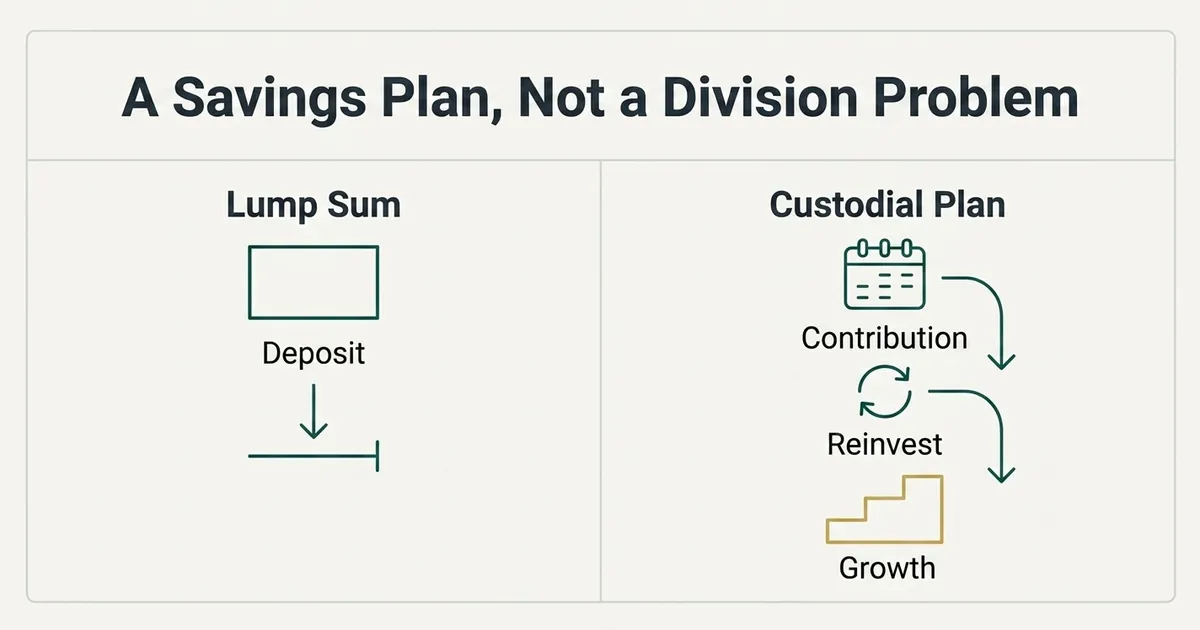
Custodial accounts build dividend income through monthly contributions and reinvestment, not a single deposit, so the math is a savings-plan formula rather than a division problem. Each dividend payment buys additional shares automatically through a dividend reinvestment plan (DRIP), and those new shares generate their own dividends the next payment cycle — a snowball effect that accelerates over time because the share count itself keeps growing, not just the share price.
Consider a custodial account opened for a newborn with $200 contributed every month, invested in a fund earning a 7% average annual total return (price growth plus reinvested dividends). After 10 years, that account holds approximately $34,600. At a 3% average yield, $34,600 throws off about $1,038 a year, or roughly $86 a month — just short of the $100/month milestone, which arrives around month 133, or about 11 years in. Cut the contribution to $100 a month instead and the same $100/month dividend milestone takes about 17 years, because the account needs more time, not just more compounding, to close a smaller-contribution gap.
According to Hartford Funds (2026), 85% of the cumulative total return of the S&P 500 Index from 1960-2025 can be attributed to reinvested dividends and the power of compounding. Skipping DRIP on a custodial account gives up that compounding edge for the sake of cash the child likely won't spend anyway.
Which Account Type Should You Use for Dividend Income?
Choose a custodial brokerage account (UTMA/UGMA) if you want the money usable for anything the child needs as an adult — extracurriculars now, a car or first apartment later — because these accounts carry no restriction on how proceeds get spent once the child gains control. Choose a 529 plan instead if the money is earmarked strictly for education, since 529 withdrawals grow and come out federal-tax-free only for qualified education expenses.
The trade-off is control and timing. According to the California Probate Code Sections 3900-3925 (enacted 1984, current 2026), a UTMA custodial account in California transfers full control to the child at age 18 by default, though the custodian can elect an extended term to age 21 or 25 at the time the account is opened — other states set their own age-of-majority rules, so verify your state's UTMA/UGMA statute before choosing an end date. A 529 plan has no such handoff: the account owner (usually the parent) keeps control indefinitely, and per ScholarShare 529 (2026), California's plan allows aggregate contributions up to $529,000 per beneficiary.
Custodial brokerage contributions also interact with gift tax rules that 529 plans handle differently. According to IRS Revenue Procedure 2025-32 (2026), the annual gift tax exclusion is $19,000 per giver per recipient, an amount the IRS adjusts annually for inflation — a family contributing $200 a month ($2,400 a year) into a custodial account stays far under that threshold. If college costs later dominate, a partial rollover is possible: according to the IRS (2024), the SECURE 2.0 Act permits up to $35,000 in lifetime rollovers from a 529 plan to the beneficiary's Roth IRA, starting in 2024, subject to the plan being open at least 15 years. Compare the full mechanics in our guide to a custodial account vs. 529 plan before opening either.
How Is a Child's Dividend Income Taxed?
Most of a child's dividend income stays untaxed or lightly taxed under the "kiddie tax" rules, but income above a set threshold is taxed at the parent's marginal rate, not the child's. According to IRS Revenue Procedure 2025-32 (October 2025), for tax year 2026 the first $1,350 of a child's unearned income (which includes dividends) is tax-free, the next $1,350 is taxed at the child's own rate, and anything above $2,700 is taxed at the parent's marginal rate under Internal Revenue Code Section 1(g). These thresholds adjust annually for inflation and were left unchanged from tax year 2025, so confirm the figures for your filing year in the Form 8615 instructions before filing.
That $2,700 parent-rate threshold matters more than most calculators show: at a 3% average yield, an account needs about $90,000 in principal before dividend income even reaches that ceiling, and at 2.5% it needs $108,000. In plain terms, a family contributing $50-$500 a month typically won't trigger the parent-rate tier for many years, which is one reason custodial dividend accounts are tax-efficient for young children specifically.
Qualified dividends — those meeting IRS holding-period rules under Internal Revenue Code Section 1(h)(11) — get taxed at long-term capital gains rates (0%, 15%, or 20%) instead of ordinary income rates. According to IRS Revenue Procedure 2025-32 (October 2025), the 0% qualified-dividend/long-term-capital-gains rate applies to taxable income up to $49,450 for single filers in 2026, a threshold that adjusts annually. A child with $1,000 in qualified SCHD dividends and no other income owes $0 in federal tax on that income even outside the kiddie-tax-free zone, because it falls under the 0% bracket.
Which Investments Actually Produce This Dividend Income?
Dividend ETFs produce more diversified, more predictable dividend income than individual stocks for accounts under roughly $5,000-$10,000, because a single ETF share spreads the payout across dozens or hundreds of companies instead of depending on one company's board of directors. Individual dividend stocks can work once the balance is large enough to hold 8-12 positions without any single stock dominating the account.
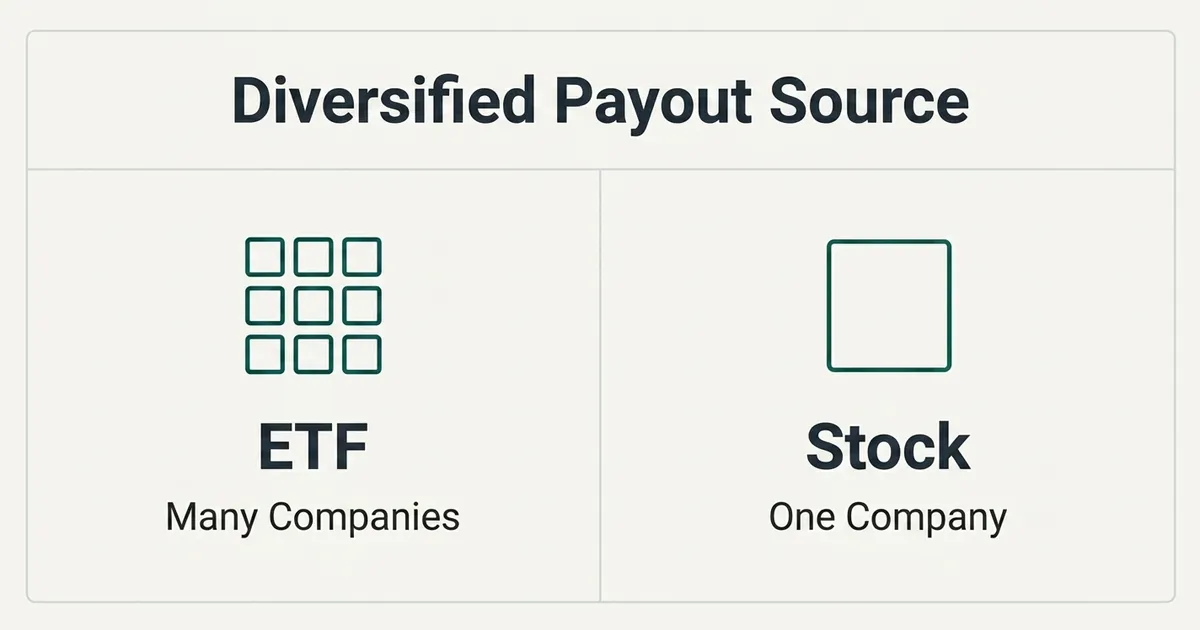
According to Charles Schwab Asset Management (2026), SCHD tracks roughly 100 U.S. companies with a history of consistent dividend growth, while according to Vanguard (2026), VYM holds several hundred dividend-paying U.S. stocks at an even lower 0.04% expense ratio. A custodial account holding one $50 share of a dividend aristocrat instead risks the entire month's contribution on one company's earnings report. Compare the full trade-offs in our breakdown of dividend ETFs vs. individual stocks and see specific picks sized for small balances in best dividend stocks for a custodial account.
How Do You Automate Growing Dividend Income?
Automating dividend income means setting two things on autopilot: the monthly contribution and the dividend reinvestment, so growth doesn't depend on a parent remembering to log in. Most brokerages let you schedule a recurring transfer (say, $100 on the 1st of every month) and separately enable DRIP so every dividend payment buys fractional shares the same day it's paid, rather than sitting as idle cash.
According to Charles Schwab (2026), fractional-share DRIP lets an account reinvest dividends as small as $1 into partial shares, compared with older DRIP programs that required a full share price before reinvesting. Automated monthly contributions also produce dollar-cost averaging: buying a fixed dollar amount on the same date each month naturally buys more shares when the price dips and fewer when it's high, which lowers the average cost per share compared with trying to time purchases manually. Walk through the exact settings, from DRIP toggles to contribution schedules, in our DRIP auto-compounding setup guide.
What Mistakes Shrink Dividend Income Before It Starts?
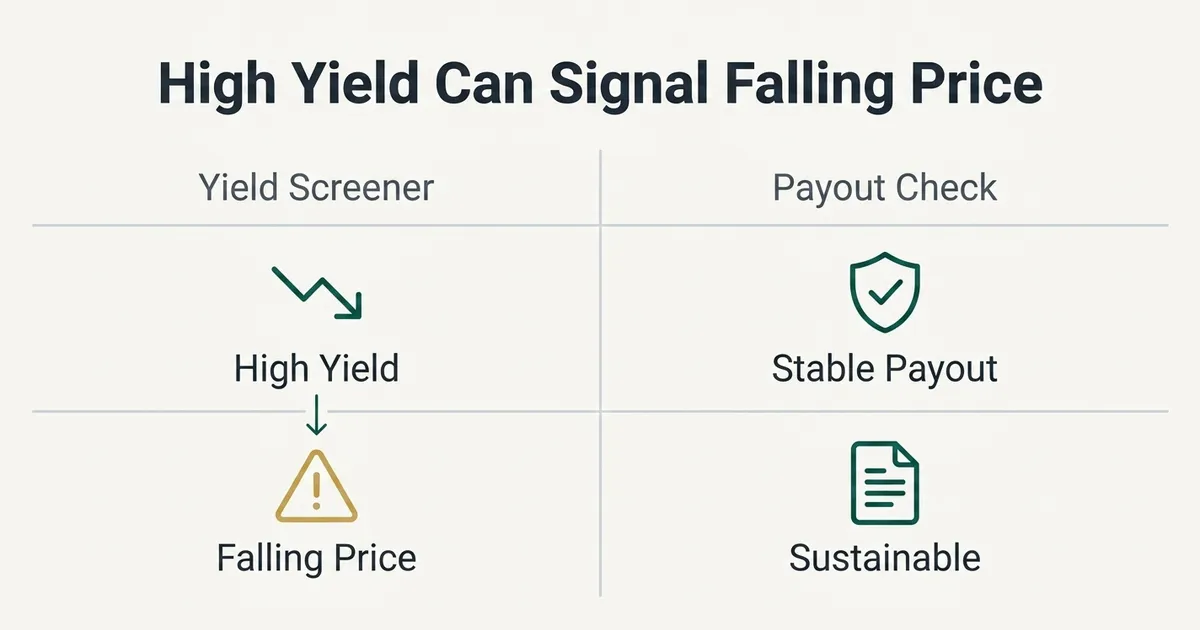
The most common mistake is chasing the highest yield on a screener instead of checking whether the payout is sustainable, because a yield that looks 3x better often reflects a falling share price rather than a generous company. The second is inconsistent contributions: skipping months breaks the dollar-cost-averaging pattern and pushes the milestone dates calculated earlier further out.
A third mistake is missing the kiddie-tax filing requirement once unearned income crosses the threshold. According to the IRS (2026), failing to file Form 8615 when required can trigger accuracy-related penalties of up to 20% of the underpayment under Internal Revenue Code Section 6662, on top of the tax owed. A fourth mistake is over-concentrating in one sector — loading a custodial account entirely with utility or REIT stocks for their higher yield raises interest-rate sensitivity risk without the diversification a broad dividend ETF provides. Do not put a child's entire custodial account into a single high-yield stock or fund chasing a headline yield above 6%-8%; spread contributions across a diversified dividend ETF first, and add individual names only once the balance and your comfort with company-specific risk both justify it.
Start with our Family Dividend Investing pillar guide for the full account-opening and portfolio-building sequence before funding your first month's contribution.
Frequently asked questions
How much money do you need to make $1,000 a month in dividends?
You need roughly $240,000 to $600,000 invested, depending on yield: at a 5% yield that's $240,000, and at a 2% yield it's $600,000. According to S&P Dow Jones Indices (2026), the average dividend yield across S&P 500 companies has historically run near 1.3%-1.5%, so a diversified dividend ETF yielding 2.7%-3.5% (like VYM or SCHD) puts the realistic range closer to $342,857-$444,444 for $1,000 a month in dividend income.
How much dividend income is taxable?
All dividend income is reportable to the IRS, but for a child under the kiddie tax rules, not all of it is taxed the same way. According to IRS Revenue Procedure 2025-32 (October 2025), the first $1,350 of a child's unearned income for tax year 2026 is tax-free, the next $1,350 is taxed at the child's own rate, and anything above $2,700 is taxed at the parent's marginal rate — figures the IRS adjusts annually for inflation.
What are examples of dividend income?
Dividend income includes cash payouts from individual stocks (such as quarterly payments from a company like Coca-Cola or Johnson & Johnson), distributions from dividend ETFs (such as SCHD or VYM), and REIT distributions from real estate investment trusts. According to the IRS (2026), all of these get reported to the recipient on Form 1099-DIV, which separates ordinary dividends from qualified dividends and capital gain distributions for tax purposes.
Do I have to pay taxes on dividends earned?
Yes — dividends are taxable in the year they're paid even if you reinvest every cent through a DRIP, because the IRS treats a reinvested dividend as constructive receipt of income. According to IRS Publication 550 (2026), this means the brokerage still issues a Form 1099-DIV for reinvested amounts, and the recipient (or their parent, under kiddie tax rules) must report that income on a tax return even though no cash ever hit a bank account.
What is the dividend income tax rate?
Qualified dividends are taxed at long-term capital gains rates of 0%, 15%, or 20% depending on taxable income, while nonqualified (ordinary) dividends are taxed at regular income tax rates of 10%-37%. According to the IRS (2026), the 0% qualified-dividend rate applies up to $49,450 of taxable income for single filers, and for a child subject to the kiddie tax, unearned income above the $2,700 threshold (tax year 2026, per IRS Revenue Procedure 2025-32) is taxed at the parent's marginal rate instead of the child's.
How do you calculate dividend income you'll earn?
Multiply the amount invested by the fund's or stock's dividend yield, then divide by 12 for a monthly figure: $10,000 invested at a 3% yield produces $300 a year, or $25 a month. According to Fidelity (2026), most brokerage dividend calculators use this same formula — principal times yield divided by payment frequency — applied to the fund's trailing 12-month distribution rate rather than a single quarter's payout, since a single quarter can overstate or understate the annual rate.