S Corp vs LLC: Which Saves Your Family More Tax in 2026?

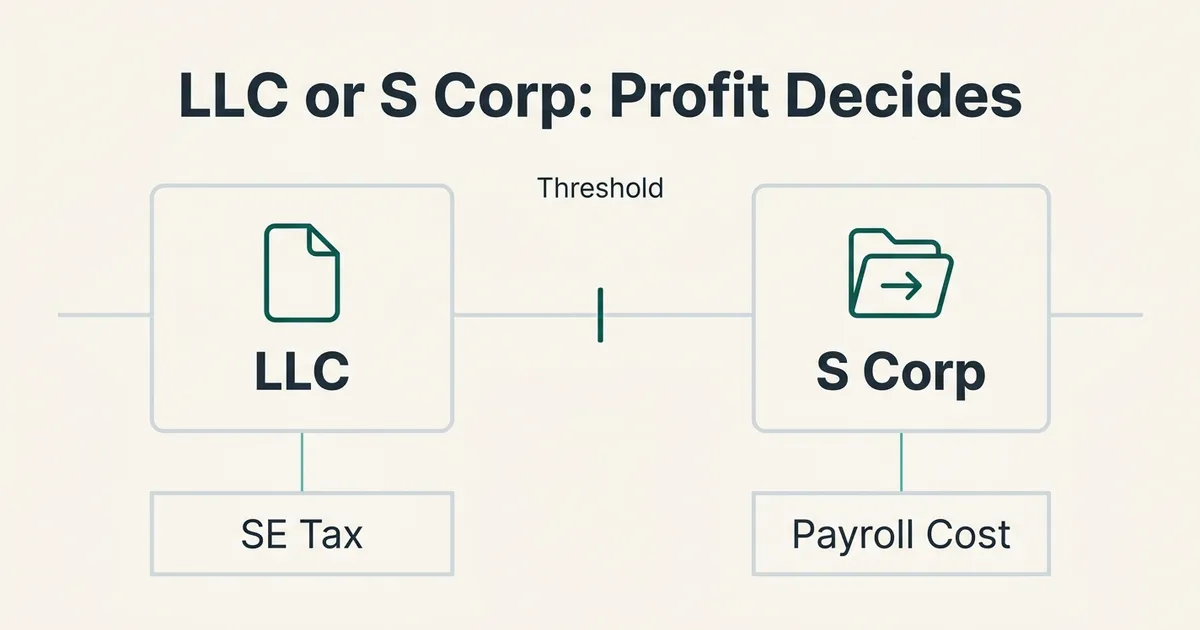
An S corp is a tax election, not a legal entity — you can run your existing LLC as an S corp and cut self-employment tax, but only once profit is high enough to cover the added payroll and filing costs. Below roughly $60,000 in net profit, a plain LLC usually wins.
That threshold isn't arbitrary — it's the point where the payroll tax you avoid by splitting income into salary and distributions exceeds the extra accounting, payroll, and state fees the S corp election creates. For a parent running a side business alongside pre-K through K-8 kids, the calculation also has to account for a rule most comparison articles skip entirely: electing S corp status can shut off a valuable family tax move — paying your own minor child tax-free wages. This guide walks through the mechanism, the real numbers, and the exact income level where switching pays off.
What Is the Real Difference Between an S Corp and an LLC?
An LLC (limited liability company) is a state-law legal entity that protects your personal assets from business debts; an S corp is a federal tax election under Internal Revenue Code Section 1361 that changes how that entity's profit gets taxed. Because of this, "LLC vs. S corp" is a slightly misleading framing — a single-member LLC can elect to be taxed as an S corp by filing Form 2553 without ever changing its state-registered legal structure. According to the IRS Instructions for Form 2553 (2025), an eligible LLC or corporation must file that election within two months and 15 days of the start of the tax year it wants the treatment to apply, or any time during the prior year.
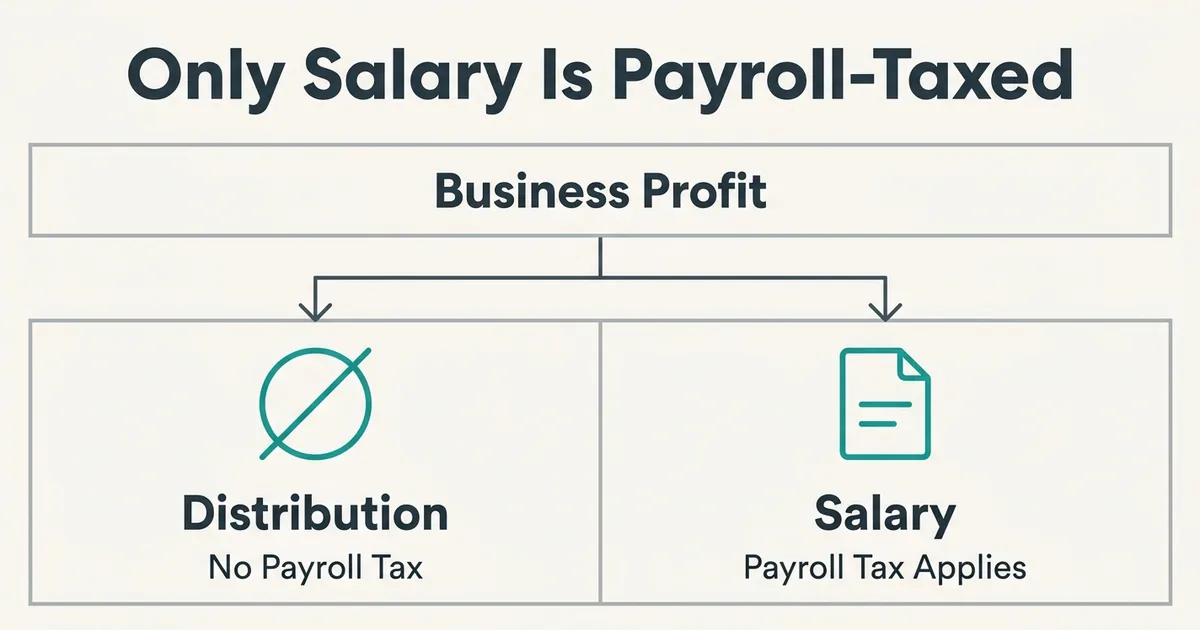
By default, a single-member LLC is a "disregarded entity" taxed like a sole proprietorship on Schedule C, and a multi-member LLC is taxed as a partnership on Form 1065 — in both cases, 100% of net profit flows to the owners' personal returns and is exposed to self-employment tax. An S corp election splits that same profit into two buckets: a W-2 salary (subject to payroll tax) and a shareholder distribution (not subject to payroll tax). That split is the entire mechanism behind every S corp tax-saving claim you'll read.
How Does an S Corp Actually Save You Money on Self-Employment Tax?
An S corp saves money by shrinking the portion of your business profit exposed to the 15.3% self-employment/payroll tax, because only your salary — not your distribution — is subject to it. According to the IRS Instructions for Schedule SE (2025), self-employment tax equals 15.3% of 92.35% of net self-employment earnings: 12.4% funds Social Security up to the annual wage base, and 2.9% funds Medicare with no cap.
Here's the arithmetic on a realistic family side business. Say your consulting or e-commerce LLC nets $100,000 in profit for the year. As a default LLC, your self-employment tax base is $100,000 × 0.9235 = $92,350, taxed at 15.3% — a bill of about $14,130, per the same IRS Schedule SE mechanics. Half of that, roughly $7,065, is deductible above the line, but the full $14,130 still leaves your pocket.
Elect S corp treatment and pay yourself a reasonable salary of $55,000, with the remaining profit taken as a distribution. Payroll tax (Social Security plus Medicare, split between employee and employer share) applies only to the $55,000: 15.3% of that is about $8,415, according to the same combined OASDI/Medicare rate structure. That's roughly $5,700 less in payroll tax than the sole-proprietor scenario — before subtracting the cost of running the election.
The catch is the word "reasonable." Per IRS Fact Sheet FS-2008-25 (2008), a reasonable S corp salary must reflect what an unrelated employer would pay for comparable work, factoring in training, time devoted, and duties performed — you can't set it at zero just to dodge payroll tax. The IRS and courts enforce this aggressively: in David E. Watson, P.C. v. United States, 668 F.3d 1008 (8th Cir. 2012), the court upheld the reclassification of a CPA's $24,000 salary against $203,651 in distributions for 2002, setting his reasonable compensation at $91,044 and generating a substantial back-tax bill.
S Corp vs LLC vs C Corp: How Do the Three Structures Compare?
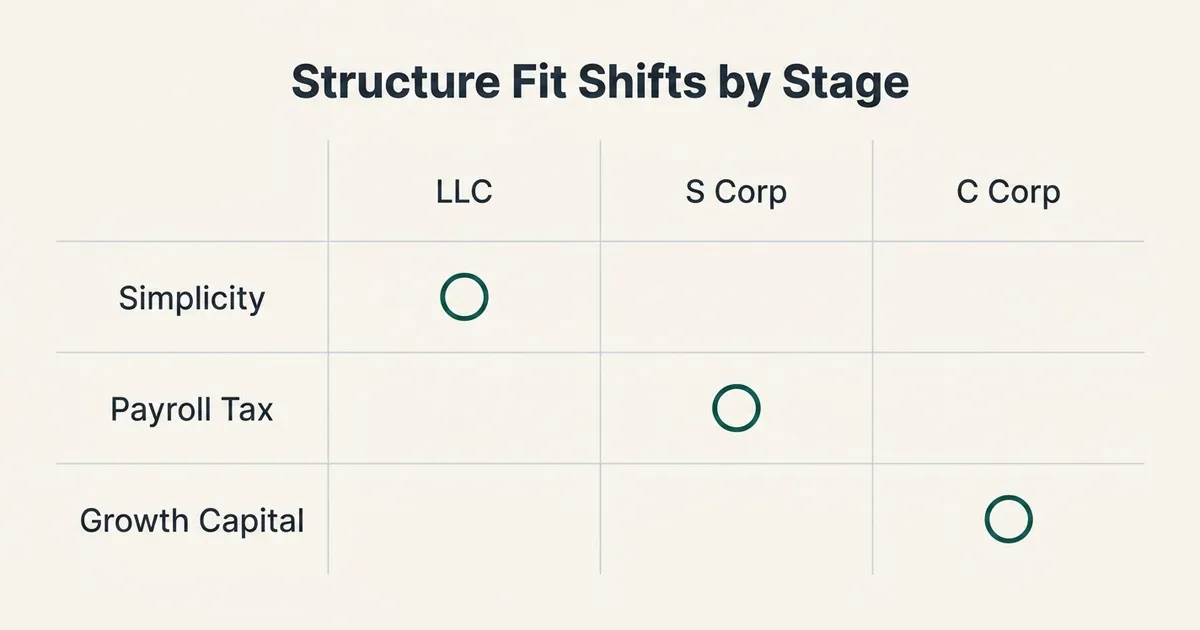
The default LLC wins on simplicity and low income, the S corp election wins on payroll-tax savings once profit is steady and substantial, and the C corp wins only when you're retaining earnings for growth or bringing in outside investors.
| Structure | How profit is taxed federally | Payroll/self-employment tax exposure | California-specific cost | Compliance burden | Best fit |
|---|---|---|---|---|---|
| Default LLC (sole prop or partnership) | 100% passes through to your Form 1040 at personal rates | Full net profit hit by 15.3% SE tax (Social Security portion capped at the wage base) | $800 minimum franchise tax plus a gross-receipts fee starting at $900 above $250,000 in California receipts (California Franchise Tax Board, 2025) | Lowest — one Schedule C or 1065, no payroll required | Net profit under ~$60,000; irregular or seasonal income |
| LLC electing S corp (Form 2553) | Passes through; split into W-2 salary + K-1 distribution | Only the salary hits 15.3% payroll tax; distributions are exempt | $800 minimum or 1.5% of net income, whichever is greater, per California Form 100S instructions (California Franchise Tax Board, 2025) | Moderate — payroll runs, Form 1120-S, reasonable-compensation documentation | Net profit above ~$70,000-$100,000, stable year-round income |
| C corp | Entity pays a flat 21% corporate rate under IRC Section 11; dividends taxed again on your 1040 | Only W-2 salary hits payroll tax; dividends face double taxation instead | $800 minimum franchise tax, per California Franchise Tax Board (2025) | Highest — corporate minutes, separate Form 1120, dividend tracking | Raising outside capital or retaining profit inside the business long-term |
For the reader this guide is written for — a parent running a side business worth $70,000 to $150,000 in annual profit — the middle row is usually the answer once the business clears the breakeven point below. The C corp row rarely fits a family side hustle; double taxation on distributed profit erases most of the payroll-tax benefit unless you're deliberately keeping cash inside the company.
At What Income Level Does an S Corp Election Start to Pay Off?
The S corp election typically pays off once net profit consistently exceeds roughly $70,000 to $80,000, because that's where payroll-tax savings overtake the added cost of running payroll, filing Form 1120-S, and paying state entity fees. Below that range, the fixed costs of the election — not the tax math — determine the answer.
Run the same $100,000 example forward with real add-on costs. Payroll platforms such as Gusto and OnPay price a solo-owner payroll run at roughly $40-$60 per month plus a small per-employee fee (Gusto, 2025; OnPay, 2025), or about $500-$700 a year. A separate S corp return (Form 1120-S) typically adds $800-$1,500 in preparation fees beyond what a Schedule C would cost. Add those together — roughly $1,300-$2,200 a year — and subtract them from the $5,700 payroll-tax savings calculated above: net benefit lands around $3,500-$4,400 in this illustrative example, not a guaranteed result, since actual salary levels, state, and expenses vary by business.
Below $60,000 in net profit, that same fixed cost block can consume the entire savings, which is why plain-LLC treatment usually wins for smaller side hustles. Above $150,000, the math tilts further toward S corp because the 2.9% Medicare portion of self-employment tax has no income cap, so every dollar of profit kept as distribution instead of salary keeps saving money as the business grows, per the uncapped-Medicare structure confirmed in IRS Schedule SE Instructions (2025).
What Does It Cost to Run an S Corp That an LLC Doesn't Have?
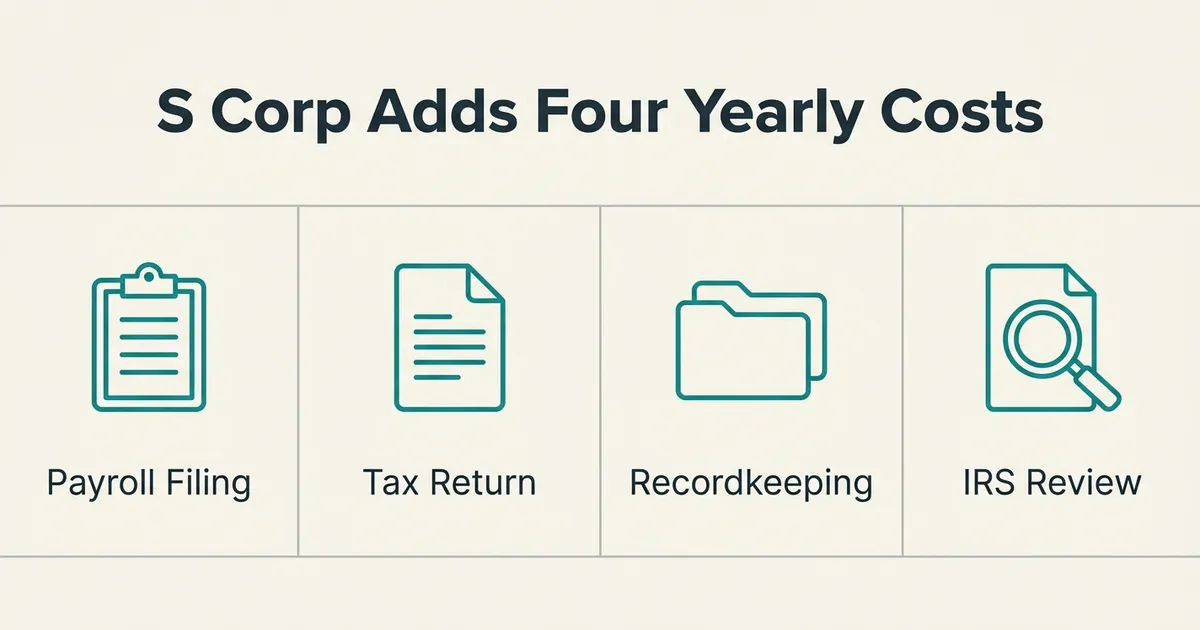
Running an S corp costs more than a default LLC because it adds payroll administration, a separate business tax return, and stricter recordkeeping that the IRS actively audits. Four costs show up every year that a Schedule C filer never sees.
- Payroll processing and tax deposits. You must run real payroll, withhold federal and state income tax, and deposit employer-side FICA and FUTA. Per IRS Instructions for Form 940 (2025), federal unemployment tax is 6.0% on the first $7,000 of wages, reduced to an effective 0.6% with the standard state credit — roughly $42 a year on a $55,000 salary.
- A separate business return. Form 1120-S is due March 15 (or the 15th day of the third month after year-end) with its own late-filing penalty structure, separate from your personal Form 1040 deadline.
- Reasonable-compensation documentation. You need comparable-wage data on file to defend your salary figure if audited, per the factors listed in IRS Fact Sheet FS-2008-25 (2008).
- State entity fees. In California, the S corp itself owes 1.5% of net income or the $800 minimum tax, whichever is greater, per Form 100S instructions (California Franchise Tax Board, 2025) — a cost layered on top of, not instead of, ordinary federal tax.
Should You Switch Your Family LLC to an S Corp?
Switch if your net profit is consistently above roughly $70,000-$80,000, your income is stable enough to commit to a documented salary, and you're not relying on paying your own minor children as a core tax strategy. Don't switch if any of those three conditions fails.
That third condition catches most parents by surprise. Per IRS Publication 15 (Circular E) (2025), wages you pay to your own child under age 18 for work in your trade or business are exempt from Social Security and Medicare tax — but only if the business is a sole proprietorship, or a partnership where every partner is a parent of that child. That exemption disappears the moment the business is a corporation, including an S corp; wages paid to your child through an S corp are fully subject to FICA like any other employee's pay. If putting your 10-year-old on the payroll to fund a custodial Roth IRA is central to your plan, run that math before you file Form 2553 — check current custodial Roth IRA providers rules on earned income before committing either way.
A second overlooked trade-off involves the home office. A sole proprietor deducts home-office expenses directly on Form 8829 attached to Schedule C. An S corp shareholder-employee can't do that on a personal return; the deduction has to run through an "accountable plan" reimbursement from the corporation to the employee, adding a layer of paperwork. Review the mechanics in our guide to home office and side-hustle deductions before assuming the deduction transfers automatically.
A third factor is the Section 199A qualified business income (QBI) deduction. Per IRS Revenue Procedure 2025-32, the 2026 QBI threshold amounts are $201,750 for single and other returns and $403,500 for married filing jointly, with phase-in ranges topping out at $276,750 and $553,500 respectively — figures the IRS adjusts annually, so confirm the current-year revenue procedure before filing. W-2 wages paid to an S corp owner don't count as qualified business income, while a sole proprietor's or partner's full net profit (minus the deductible SE tax portion) does — so at moderate income levels, the S corp split can shrink your QBI deduction even as it shrinks your payroll tax, partly offsetting the savings.
How Does California Treat S Corps and LLCs Differently?
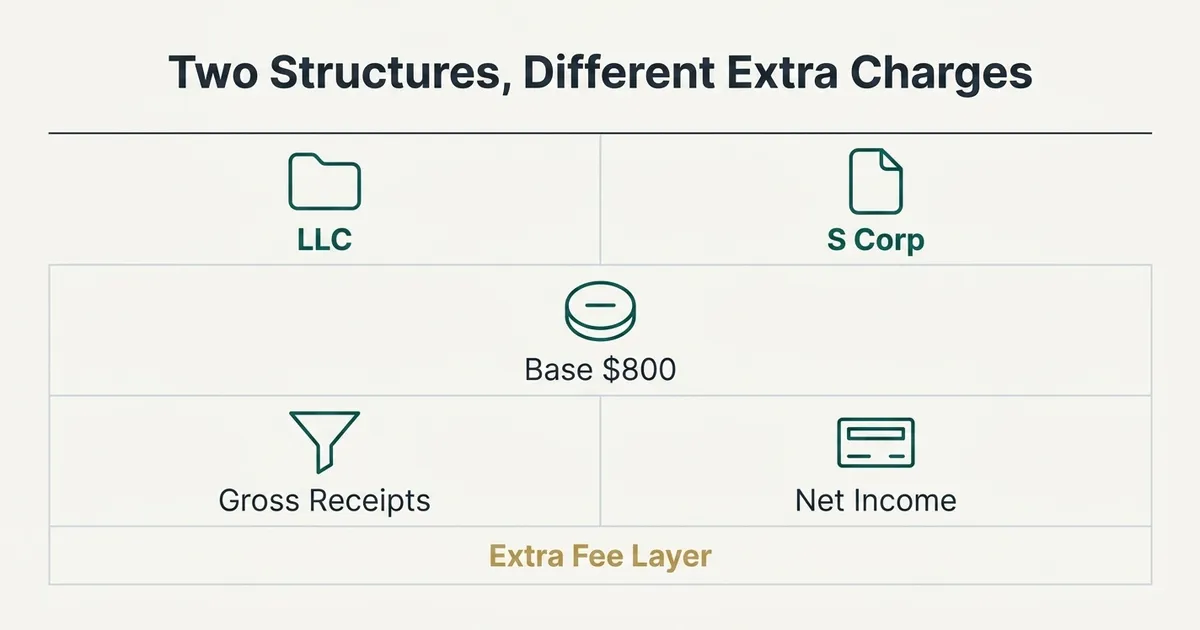
California taxes both structures with an $800 annual minimum, but layers different extra charges on top: LLCs pay a gross-receipts-based fee, while S corps pay a net-income-based tax. Because the two fees use different bases, a business with high revenue but thin margins can owe more as an LLC, while a high-margin business can owe more as an S corp.
Per the California Franchise Tax Board (2025), a California LLC owes the $800 minimum franchise tax plus an additional LLC fee starting at $900 once total California-sourced receipts hit $250,000, scaling up to $11,790 at $5,000,000 or more — regardless of how much profit remains after expenses. A California S corp instead owes the greater of $800 or 1.5% of net income, per Form 100S instructions (California Franchise Tax Board, 2025); on the $100,000-profit example above, with roughly $41,000 left as corporate net income after the $55,000 salary, 1.5% works out to about $615 — below the $800 floor, so the corporation pays $800 either way. States without an income tax, such as Texas and Florida, don't impose this layer at all, so the state-level math shifts meaningfully depending on where you live — verify your own state's franchise, excise, or annual-report fee before comparing.
What Are the Biggest S Corp Mistakes Parents Running a Side Business Make?
The most common S corp mistake is setting salary too low relative to distributions, followed closely by missing the Form 2553 election deadline and skipping payroll tax deposits. Each one carries a specific, checkable fix.
- Underpaying salary. As the Watson case above shows, the IRS reclassifies distributions as wages when salary looks token, adding back payroll tax plus penalties and interest.
- Missing the election window. File after the two-months-and-15-days deadline in IRS Instructions for Form 2553 (2025) and you lose the current year's benefit — though IRS Revenue Procedure 2013-30 (2013) allows late-election relief for reasonable cause if filed within three years and 75 days of the intended effective date.
- Skipping quarterly payroll deposits. Employer payroll tax deposits generally follow a monthly or semi-weekly schedule tied to your total tax liability; missing them triggers Form 941 late-deposit penalties separate from any income-tax penalty.
- Commingling funds. Running personal and business money through the same account undermines both the liability shield and the "separate entity" treatment the IRS expects from a corporation.
- Forgetting the child-wage exemption trade-off. As covered above, moving to an S corp removes the FICA exemption on wages paid to your own minor child — a cost that's easy to miss when the pitch is framed purely as "save on self-employment tax."
Redirecting whatever you do save is where the pillar strategy connects: dollars freed up by smarter entity taxation can fund a child's custodial account, cover maximizing the Child Tax Credit planning around income phase-outs, or even pair with residential solar tax credits if you're also cutting utility costs. For the full framework on lowering your household's federal tax drag before investing the difference, see the Family Tax Hacking pillar guide.
Frequently asked questions
What are the S corp disadvantages?
The main S corp disadvantages are added payroll administration, a separate Form 1120-S filing, mandatory reasonable-compensation documentation, and loss of the FICA exemption on wages paid to your own minor children. Per IRS Fact Sheet FS-2008-25 (2008), you must also be able to defend your salary figure with comparable-wage evidence if audited, and per IRS Publication 15 (2025), corporations — unlike sole proprietorships — can't exempt a child's wages from Social Security and Medicare tax. States such as California add a further net-income-based entity tax (1.5%, minimum $800, per California Franchise Tax Board, 2025) that a default LLC doesn't owe in the same form.
Should I switch my LLC to an S corp?
Switch only if your LLC's net profit is consistently above roughly $70,000-$80,000 a year, because that's typically where payroll-tax savings — about $5,700 on a $100,000-profit example using 2025 self-employment tax mechanics per IRS Schedule SE Instructions (2025) — exceed the added payroll and filing costs of $1,300-$2,200 a year. Below that range, or if your income swings unpredictably month to month, the fixed compliance costs usually erase the benefit, so staying a default LLC is the better choice.
Do you pay more taxes as an LLC or S corp?
A default LLC owner generally pays more in combined self-employment/payroll tax than an S corp owner at the same profit level, because 100% of LLC profit is exposed to the 15.3% self-employment tax while only the S corp's salary portion is, per IRS Schedule SE Instructions (2025). On $100,000 of net profit, that's roughly $14,130 in self-employment tax as an LLC versus about $8,415 in payroll tax on a $55,000 S corp salary — a gap of about $5,700 before accounting for the extra $1,300-$2,200 a year the S corp election costs to administer.
Why do an S corp instead of an LLC?
You elect S corp treatment instead of staying a default LLC specifically to shrink the profit exposed to the 15.3% self-employment tax, since only your documented salary — not your shareholder distribution — is subject to it, per IRS Schedule SE Instructions (2025). The benefit scales with profit: at $70,000-$80,000 it roughly breaks even against added payroll and filing costs, and above $150,000 it keeps growing because the 2.9% Medicare portion of self-employment tax has no income cap.
What are the S corp vs LLC pros and cons?
An S corp's main pro is payroll-tax savings on profit above roughly $70,000-$80,000 a year, while its main con is added payroll administration, a separate Form 1120-S return, and loss of the FICA exemption on wages paid to your own minor child, per IRS Publication 15 (2025). A default LLC's main pro is simplicity — one Schedule C or Form 1065, no payroll required — while its main con is that 100% of net profit is exposed to the full 15.3% self-employment tax under IRS Schedule SE Instructions (2025), with no ability to shelter part of it as a distribution.
How does an S corp compare to an LLC and a C corp?
An S corp and a default LLC are both pass-through structures where profit is taxed once on the owner's personal return, while a C corp pays its own 21% flat corporate tax under Internal Revenue Code Section 11 and then taxes dividends again on the owner's return. Among the pass-through options, the S corp splits profit into salary (taxed at 15.3% payroll tax) and distribution (exempt from it), while the default LLC exposes the entire profit to that 15.3% rate, per IRS Schedule SE Instructions (2025); the C corp is generally reserved for businesses retaining earnings for growth or preparing to bring in outside investors rather than for a family side business distributing profit to its owner each year.